Imagine trying to identify every resident of a bustling metropolis from a rooftop, at night, with only a handful of flashlights. That’s essentially the challenge cell biologists face when trying to track individual proteins inside a cell packed with millions of molecular neighbors. A new tool called NovoTags is about to hand researchers a lot more flashlights — and much brighter ones.
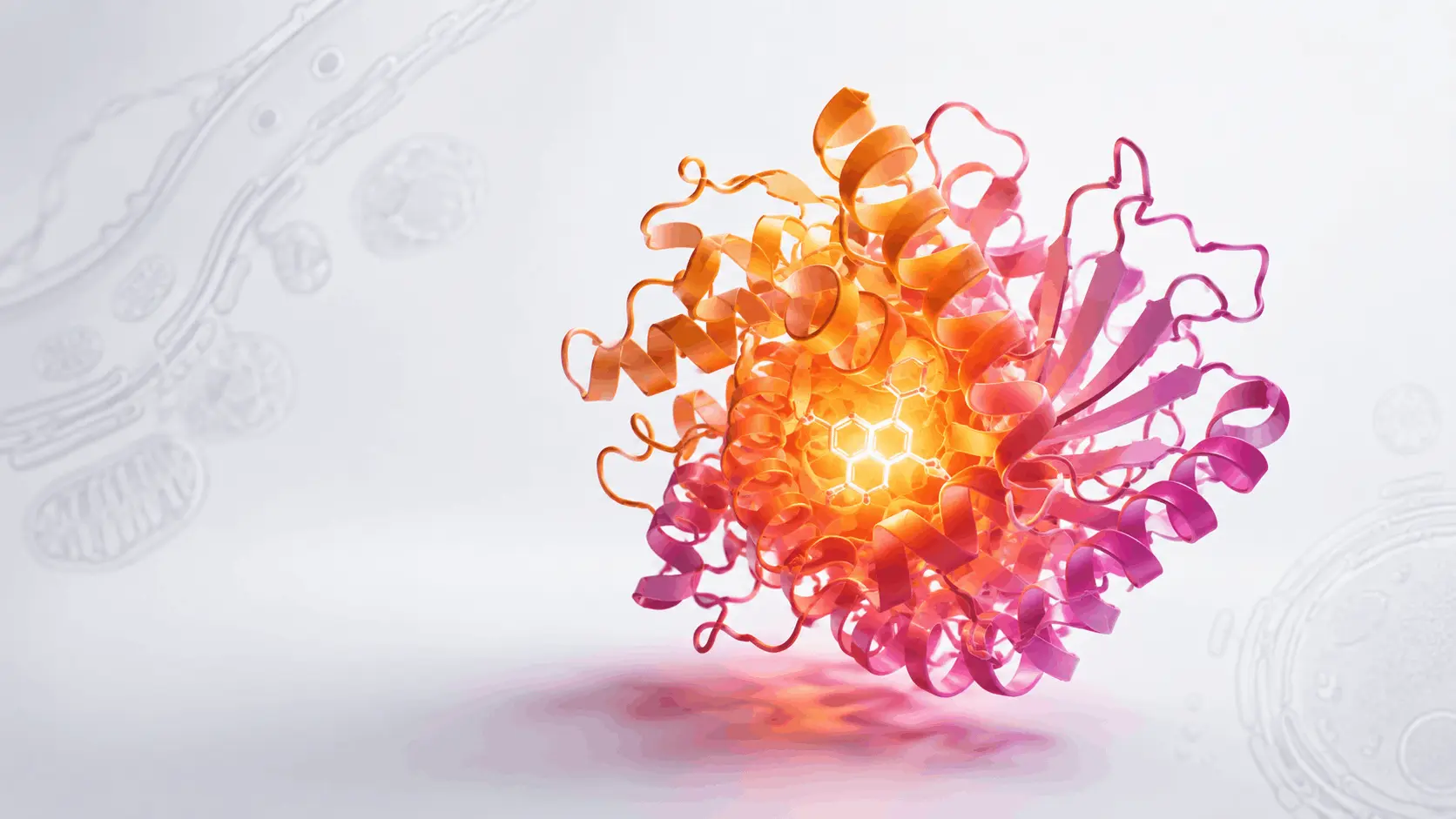
Developed through a collaboration between the Baker Lab at the University of Washington, the Lavis Lab at Janelia Research Campus, and the Mahamid Group at EMBL Heidelberg, NovoTags are synthetic, AI-designed proteins that bind with high specificity to ultra-bright fluorescent dyes. The work, published in Science, marks a significant expansion of the fluorescent labeling toolkit and opens new doors for multicolor imaging.
What Makes NovoTags Different
Unlike traditional fluorescent tags such as GFP or enzyme-based systems like HaloTag and SNAP-tag, NovoTags are designed completely from scratch using AI-driven protein design pioneered by Nobel laureate David Baker. Researchers used tools like RFdiffusion to generate protein backbones and LigandMPNN to build matching amino acid sequences, then filtered candidates computationally with AlphaFold and RoseTTAFold before validating them experimentally.
The result: small, genetically encodable proteins that bind specific Janelia Fluor (JF) dyes spanning the visible spectrum — giving researchers exceptional brightness and flexibility for imaging experiments.
NovoSplit: A Controllable Molecular Switch
One of the most compelling innovations is NovoSplit, an inducible version of NovoTags engineered by EMBL’s Steffen Klein. NovoSplit is split into two halves, each fused to a different protein of interest. The two halves only assemble when a specific dye is introduced, acting like molecular glue. This gives scientists precise, chemically controlled command over when and where two proteins interact — a powerful feature for studying dynamic protein-protein interactions in real time.
Seeing More, More Clearly
By combining spectral separation with fluorescence lifetime imaging microscopy (FLIM), researchers estimate NovoTags could eventually allow simultaneous tracking of up to 30 different proteins in a single cell, each distinguished by a unique combination of color and fluorescence lifetime. In practice, this has already enabled super-resolution STED imaging of endosomes, mitochondria, and chromatin simultaneously within the same human cell.
Actionable Takeaways for Researchers
- Explore multiplexed imaging designs: If your lab studies protein interactions or co-localization, NovoTags’ expanded color palette could simplify experiments that previously required complex spectral unmixing.
- Consider inducible systems for interaction studies: NovoSplit offers a chemically controlled alternative to constitutive tagging methods, useful for time-resolved interaction studies.
- Watch the cryo-CLEM space: NovoSplit is being developed as a foundation for inducible cryo-correlative light and electron microscopy (cryo-CLEM) tags, which could bridge fluorescence and structural imaging at near-atomic resolution.
- Access is open: NovoTag sequences and compatible dyes are freely available to the scientific community, lowering the barrier to adoption.
The Road Ahead
With backing from HHMI’s $500 million AI@HHMI initiative, the Baker and Lavis labs are already expanding the NovoTag collection. As Julia Mahamid’s group at EMBL continues pushing in situ cryo-electron tomography forward, NovoTags could become a critical bridge between light microscopy and structural biology — helping researchers map not just where proteins are, but how they behave in their native cellular context.
Article Source: Reference Article | Reference Paper Abstract
Disclaimer:
The research discussed in this article was conducted and published by the authors of the referenced paper. CBIRT has no involvement in the research itself. This article is intended solely to raise awareness about recent developments and does not claim authorship or endorsement of the research.
Follow Us!
Learn More:

Dr. Tamanna Anwar is a Scientist and Co-founder of the Centre of Bioinformatics Research and Technology (CBIRT). She is a passionate bioinformatics scientist and a visionary entrepreneur. Dr. Tamanna has worked as a Young Scientist at Jawaharlal Nehru University, New Delhi. She has also worked as a Postdoctoral Fellow at the University of Saskatchewan, Canada. She has several scientific research publications in high-impact research journals. Her latest endeavor is the development of a platform that acts as a one-stop solution for all bioinformatics related information as well as developing a bioinformatics news portal to report cutting-edge bioinformatics breakthroughs.
- Dr. Tamanna Anwar
- Dr. Tamanna Anwar
- Dr. Tamanna Anwar
- Dr. Tamanna Anwar
- Dr. Tamanna Anwar
- Dr. Tamanna Anwar
- Dr. Tamanna Anwar
- Dr. Tamanna Anwar
- Dr. Tamanna Anwar
- Dr. Tamanna Anwar
- Dr. Tamanna Anwar
- Dr. Tamanna Anwar
- Dr. Tamanna Anwar
- Dr. Tamanna Anwar
- Dr. Tamanna Anwar
- Dr. Tamanna Anwar
- Dr. Tamanna Anwar
- Dr. Tamanna Anwar
- Dr. Tamanna Anwar
- Dr. Tamanna Anwar
- Dr. Tamanna Anwar
- Dr. Tamanna Anwar
- Dr. Tamanna Anwar
- Dr. Tamanna Anwar
- Dr. Tamanna Anwar
- Dr. Tamanna Anwar
- Dr. Tamanna Anwar
- Dr. Tamanna Anwar
- Dr. Tamanna Anwar
- Dr. Tamanna Anwar
- Dr. Tamanna Anwar
- Dr. Tamanna Anwar
- Dr. Tamanna Anwar
- Dr. Tamanna Anwar
- Dr. Tamanna Anwar
- Dr. Tamanna Anwar
- Dr. Tamanna Anwar
- Dr. Tamanna Anwar
- Dr. Tamanna Anwar
- Dr. Tamanna Anwar
- Dr. Tamanna Anwar
- Dr. Tamanna Anwar