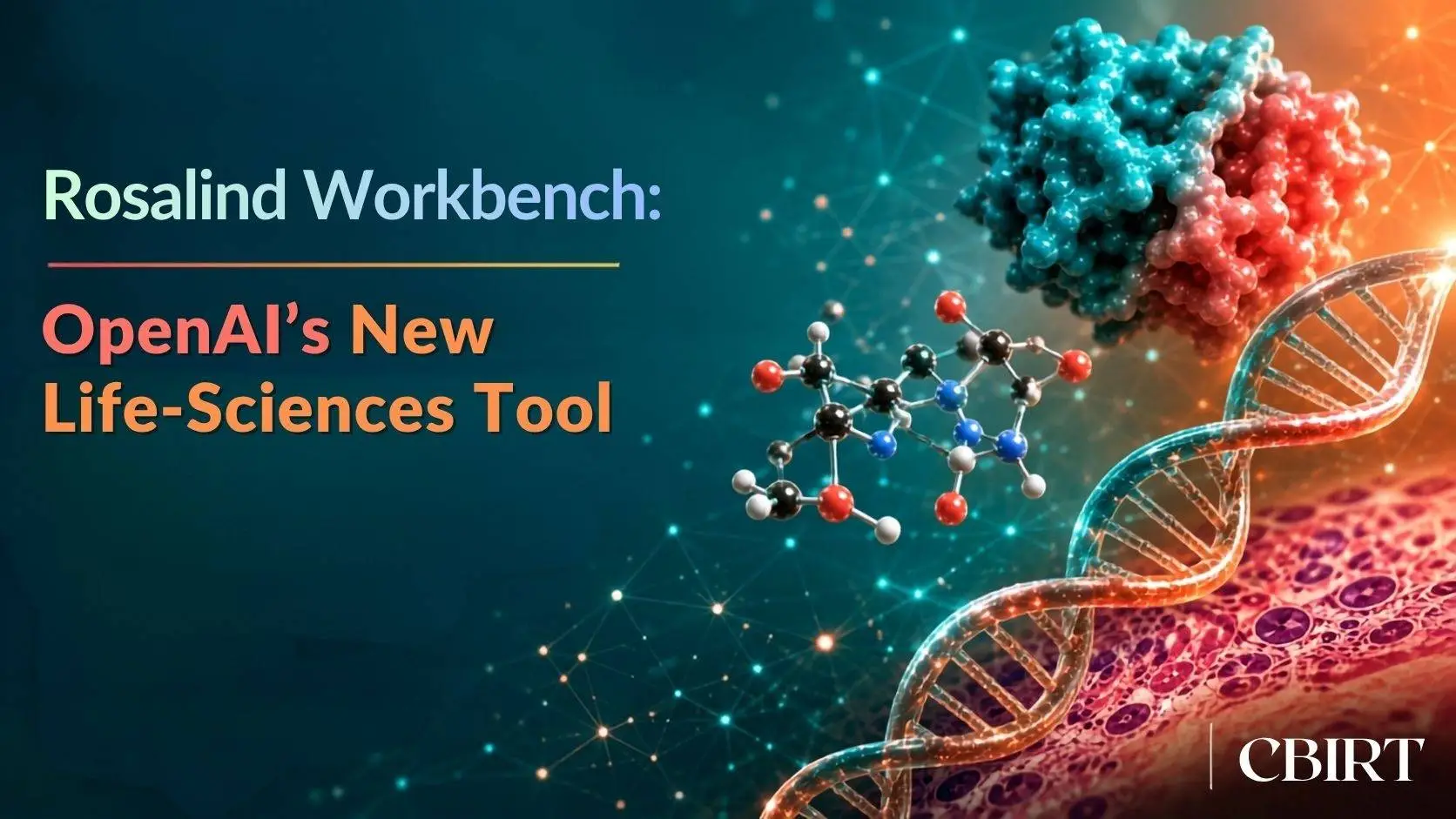
OpenAI has introduced Rosalind Workbench, a new research-preview environment available through the ChatGPT app that brings scientific tools, specialized biology models, and data workflows into a single connected space — letting researchers move from a biological question to inspectable evidence without losing the thread between disconnected tools.
Scientific research rarely happens inside a single application. A biological question can require genomic data, molecular structures, literature evidence, image analysis, and computational workflows, with each step potentially handled by a different tool. OpenAI says this fragmentation can make it difficult to maintain a clear connection between the original question, the analysis, and the evidence behind a result.
On August 28, 2026, OpenAI launched Rosalind Workbench, a research-preview environment developed to bring these pieces together. The Workbench combines guided scientific tasks, specialized biology models, scientific viewers, and data-analysis workflows in one environment.
From a biological question to a connected workflow
Rosalind Workbench is built around the idea that researchers should be able to begin with a biological question and then adapt a guided workflow to their own data, methods, and research goals. According to OpenAI, the system keeps the plan, intermediate results, and supporting evidence connected as researchers move between specialized tools.
The Workbench builds on GPT-Rosalind, OpenAI’s dedicated life sciences model. The company describes GPT-Rosalind as combining reasoning capabilities with specialized tool orchestration across areas including medicinal chemistry, genomics, and wet-lab assistance.
The approach is therefore broader than asking an AI model a scientific question in isolation. The intended workflow connects model reasoning with tools that researchers can use to inspect scientific data and carry out analysis.
Scientific data can be inspected alongside the analysis
OpenAI highlights several specialized viewers within Rosalind Workbench.
The Molecular Structure Viewer allows researchers to examine three-dimensional protein structures while keeping the scientific request and the model’s interpretation connected to the structural data. In one example, the Workbench explores GLP1R (glucagon-like peptide-1 receptor) bound to semaglutide and can create a movie highlighting features of the protein complex.
The Biological Sequence & Alignment Viewer provides another example. OpenAI demonstrates an alignment involving variants of green fluorescent protein (GFP) including avGFP, EGFP, EBFP, and ECFP, with the system connecting differences in sequence to changes in fluorescent properties.
A Slide Viewer is also demonstrated for examining tissue slides and identifying regions that may require further inspection by a pathologist.
OpenAI frames these examples as illustrating the Workbench’s central design principle: scientific data and the reasoning around it are meant to stay connected within the same research workflow.
Bringing NGS analysis into the workflow
Genomics is another major component of the system. OpenAI says Rosalind NGS Workbench is designed to connect sequencing-analysis steps that can include FASTQ inputs, quality control, bulk RNA-seq, and single-cell analysis.
According to the company, sequencing analysis can involve several connected decisions, including matching files with metadata, assessing quality, identifying biological replicates, and selecting an appropriate statistical design. Rosalind is described as drafting an analysis plan for the researcher to sign off on, then running the chosen tools and handing back outputs that the researcher can trace and review.
One example starts with a dexamethasone-treated airway RNA-seq task. Another shows a prompt asking the NGS Analysis Workbench to run FastQC and recommend whether trimming is needed.
The significance of this approach is not that the individual analyses are new. Rather, the Workbench attempts to connect the decisions and tools involved in an analysis into a single reviewable process.
What Rosalind Workbench could change
If the workflow operates as described, keeping the research question, tools, intermediate results, and evidence connected could reduce some of the context switching involved in computational research. Researchers could potentially spend less time reconstructing what happened during earlier steps and more time evaluating the resulting evidence.
This is an implication of the workflow design, but not something that has been scientifically proven through a comparative study conducted independently of the workflow design. The OpenAI announcement includes demos and product features, but not the scientific evaluation of productivity and results.
OpenAI frames this as an early step toward a larger ambition — eventually coordinating multiple agents across scientific domains so researchers can draw on wider expertise and take on more ambitious questions.
Limitations and what’s next
Rosalind Workbench is presently noted to be available in research preview on the ChatGPT application, so its accessibility and functionalities should not be compared to those of an existing research platform.
The announcement does not report a conventional experimental sample size or a peer-reviewed validation of the Workbench itself. These examples only show the capacity of the system to integrate scientific questions and scientific tools, but not any clinical value, research value, or scientific discovery.
OpenAI currently describes two modes: Explore mode for general scientific questions, and Research mode for more complex biological questions, in-depth analysis, and advanced research workflows. Verified organization members can request Research mode access on behalf of their organization; individual access is described by OpenAI as coming soon.
Takeaway
Rosalind Workbench represents OpenAI’s effort to move AI-assisted life-sciences research beyond isolated question-and-answer interactions toward connected, tool-driven workflows. Its emphasis is on linking biological questions with analysis tools, scientific data, and reviewable evidence.
The development is especially significant for bioinformatics and computational biology, given that the examples include applications within sequencing processes, such as quality control and RNA-seq. It remains to be seen whether or not this method increases efficiency in research or contributes to results in science.
Source: Reference Article
Disclaimer:
The research discussed in this article was conducted and published by the authors of the referenced paper. CBIRT has no involvement in the research itself. This article is intended solely to raise awareness about recent developments and does not claim authorship or endorsement of the research.
Important Note: This blog is based on a company announcement rather than a peer-reviewed publication. Accordingly, it should be understood as reporting on a product launch, not established or peer-reviewed research, and it should not be treated as conclusive evidence or used to guide clinical practice or health-related decisions. The claims described here have not undergone independent scientific validation and should not be considered confirmed.
Follow Us!
Learn More:


Dr. Tamanna Anwar is a Scientist and Co-founder of the Centre of Bioinformatics Research and Technology (CBIRT). She is a passionate bioinformatics scientist and a visionary entrepreneur. Dr. Tamanna has worked as a Young Scientist at Jawaharlal Nehru University, New Delhi. She has also worked as a Postdoctoral Fellow at the University of Saskatchewan, Canada. She has several scientific research publications in high-impact research journals. Her latest endeavor is the development of a platform that acts as a one-stop solution for all bioinformatics related information as well as developing a bioinformatics news portal to report cutting-edge bioinformatics breakthroughs.