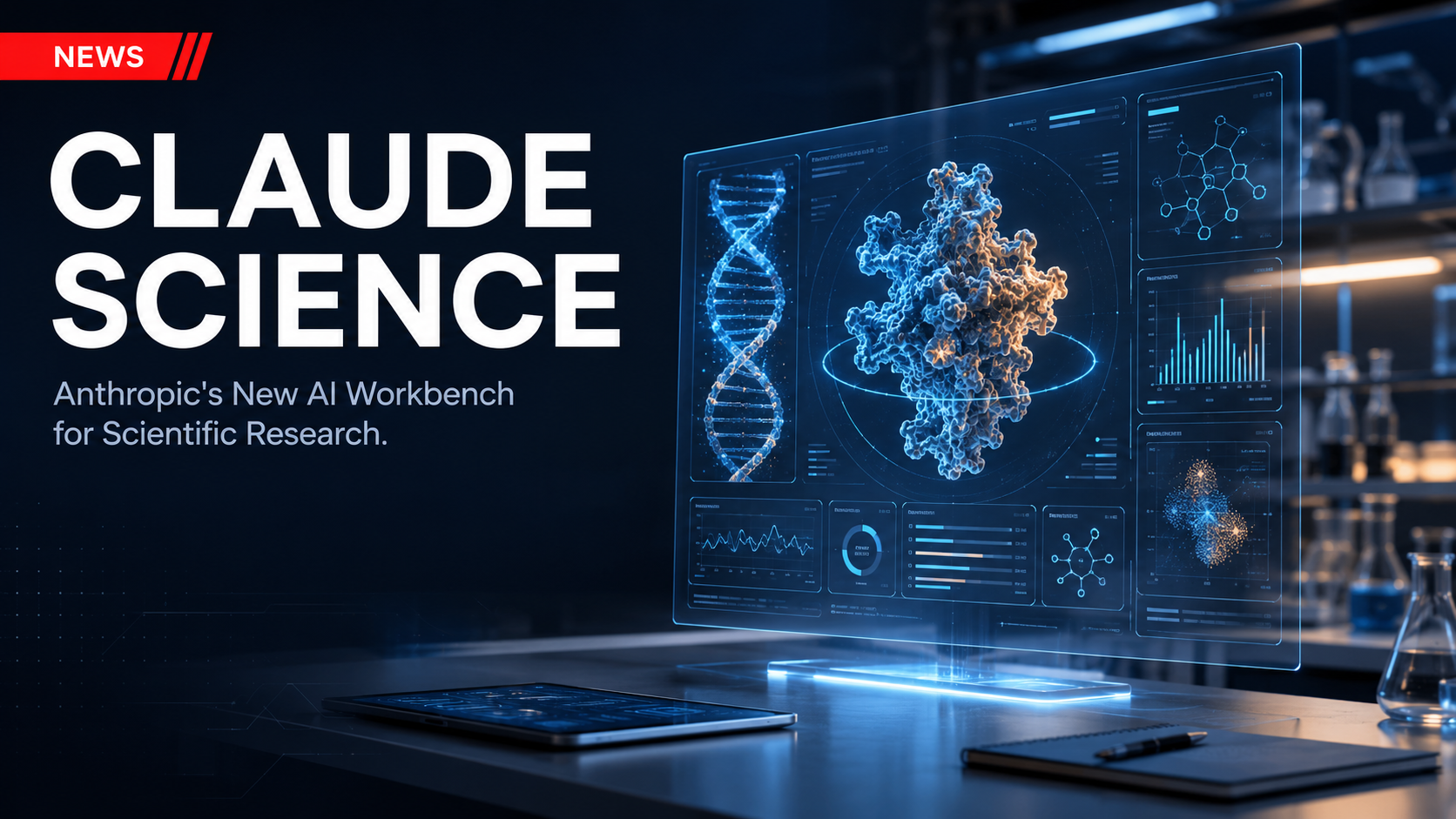
Artificial intelligence is rapidly becoming an indispensable research partner in the life sciences. But while many AI tools excel at writing code or summarizing papers, scientific discovery demands much more—it requires integrating literature, analyzing complex datasets, running computational workflows, and generating testable hypotheses. That’s where Claude Science enters the picture.
Claude Science, which was recently launched by Anthropic, is an AI workbench made especially for scientific research. It is not a new AI model — it runs on Anthropic’s existing Claude models, including Claude Opus 4.8 — but rather an application where researchers can access scientific tools, databases, and compute infrastructure through a single interface.
What Is Claude Science?
Claude Science is an AI-powered research workspace designed to streamline the entire scientific workflow. Instead of switching between literature databases, notebooks, computational platforms, and coding environments, researchers can work within a single interface that connects Claude with scientific resources and compute infrastructure.
Importantly, Anthropic emphasizes that Claude Science is not a new foundation model. It runs on the same Claude models already available today, including Claude Opus 4.8, but adds an integrated research environment tailored for scientific discovery. The app comes pre-configured with connections to more than 60 scientific databases and tools — including PubMed, UniProt, PDB, and NVIDIA BioNeMo skills such as Evo 2, Boltz-2, and OpenFold3 — and can run locally on macOS or Linux, or remotely over SSH or an HPC login node, so large or sensitive datasets stay on a lab’s own infrastructure. The platform aims to reduce the friction of managing fragmented research tools, enabling scientists to spend more time on science and less on workflow management.
Why It Matters for Biology and Bioinformatics
Modern biological research generates enormous volumes of data—from next-generation sequencing and proteomics to structural biology and single-cell omics. Extracting meaningful insights often requires combining multiple software tools, programming languages, and databases.
Claude Science is designed to simplify these workflows by enabling researchers to:
- Search and synthesize scientific literature.
- Analyze biological datasets.
- Coordinate computational pipelines.
- Generate and refine research hypotheses.
- Work alongside external scientific tools and computing resources.
Rather than replacing domain expertise, the platform serves as an intelligent research assistant, accelerating routine computational tasks while enabling scientists to focus on experimental design and biological interpretation.
Built for AI-Assisted Scientific Discovery
One of the most interesting aspects of Claude Science is its emphasis on orchestrating scientific workflows instead of simply answering questions. A generalist coordinating agent delegates work to specialist agents for tasks like genomics, single-cell, proteomics, and cheminformatics, while a separate reviewer agent checks citations, calculations, and figures against their underlying code, flagging inconsistencies before results reach the user.
Early users have reported concrete gains: Jérôme Lecoq’s team at the Allen Institute used it to build a literature-review pipeline that cut a process once taking up to two years down to producing 100-page, citation-checked reviews, and Stephen Francis’s group at the UCSF Brain Tumor Center reported completing germline analyses of glioma in roughly a tenth of the previous time. These are single-lab testimonials from launch partners rather than independent benchmarks, so they’re worth treating as early signal rather than settled performance claims.
Anthropic is positioning the platform as part of its broader AI for Science initiative, with an initial focus on biology and biomedical research. Alongside the launch, the company announced support for up to 50 Claude Science AI for Science projects, offering up to $30,000 in Claude credits per project (with Modal providing up to $2,000 in additional compute for select projects). Applications are open through July 15, 2026.
How Researchers Can Get the Most from Claude Science
Claude Science is currently available in beta for macOS and Linux on Pro, Max, Team, and Enterprise plans (Team and Enterprise admins need to enable it first), with a discounted Team plan available for academic and nonprofit research labs. If you’re considering incorporating Claude Science into your research workflow, here are a few practical strategies:
- Use it to rapidly summarize newly published papers before conducting deeper critical reviews.
- Leverage it for exploratory analysis and brainstorming rather than treating its outputs as conclusions.
- Combine AI-generated insights with established bioinformatics pipelines and experimental validation.
- Always verify computational predictions using appropriate biological expertise and laboratory evidence.
Like any AI system, Claude Science is most valuable when paired with human scientific judgment rather than used as a replacement for it.
The Bottom Line
As the impact of AI on life sciences progresses further, Claude Science is yet another step in the direction of AI-driven scientific discovery. Through integrating literature review, computational pipelines, and scientific inference into one single platform, Anthropic intends to make life science research faster and more collaborative.
Life science researchers in biology, biotechnology, and bioinformatics should keep a close eye on Claude Science, especially because experimental validation is still a must. Tools such as these might cut down the time needed for moving through multiple pieces of software and getting to the biological insight.
If you are working in computational biology or biomedical research, this might be the right time to try using artificial intelligence workbenches such as Claude Science alongside your existing processes. This could help you get ahead of the curve as artificial intelligence takes an important role in science.
Article Source: Reference Article | Availability: Web Link
Disclaimer:
The research discussed in this article was conducted and published by the authors of the referenced paper. CBIRT has no involvement in the research itself. This article is intended solely to raise awareness about recent developments and does not claim authorship or endorsement of the research.
Follow Us!
Learn More:



Dr. Tamanna Anwar is a Scientist and Co-founder of the Centre of Bioinformatics Research and Technology (CBIRT). She is a passionate bioinformatics scientist and a visionary entrepreneur. Dr. Tamanna has worked as a Young Scientist at Jawaharlal Nehru University, New Delhi. She has also worked as a Postdoctoral Fellow at the University of Saskatchewan, Canada. She has several scientific research publications in high-impact research journals. Her latest endeavor is the development of a platform that acts as a one-stop solution for all bioinformatics related information as well as developing a bioinformatics news portal to report cutting-edge bioinformatics breakthroughs.