Biology today produces more data than anyone knows what to do with. Sequencers spit out genomes, single-cell experiments generate massive expression matrices, proteomics platforms churn out thousands of protein measurements, and yet, turning all of that into an actual understanding of what is happening inside a cell or a disease remains painfully slow. A team of researchers from BGI Research, working across labs in Beijing, Wuhan, and Belgrade, recently posted a preprint describing a new system built to close that gap. They call their system BiOmics, and it’s an attempt to build something bioinformatics has been missing for a while: an AI agent that doesn’t just crunch numbers, but reasons through biological questions using real, traceable knowledge.
Why does this problem need solving?
Most AI tools in biology fall into one of two camps. On one side, you have models like scGPT or Geneformer, which are trained on huge amounts of single-cell data and are very good at recognizing patterns. The catch is that these models are essentially black boxes. They can tell you a cell probably belongs to a certain type or that a gene is probably important, but they can’t tell you why, and they can’t connect that observation to the rest of what’s known about biology.
On the other side, there are AI agents built to automate bioinformatics pipelines, running clustering, differential expression, that sort of thing. These agents are efficient at executing code, but once the analysis is done, the interpretation is left entirely to the human scientist. Existing knowledge graph tools try to bridge this by linking data to curated biological databases, but most of them work off static, fixed snapshots of knowledge that don’t update and don’t reason dynamically with new data.
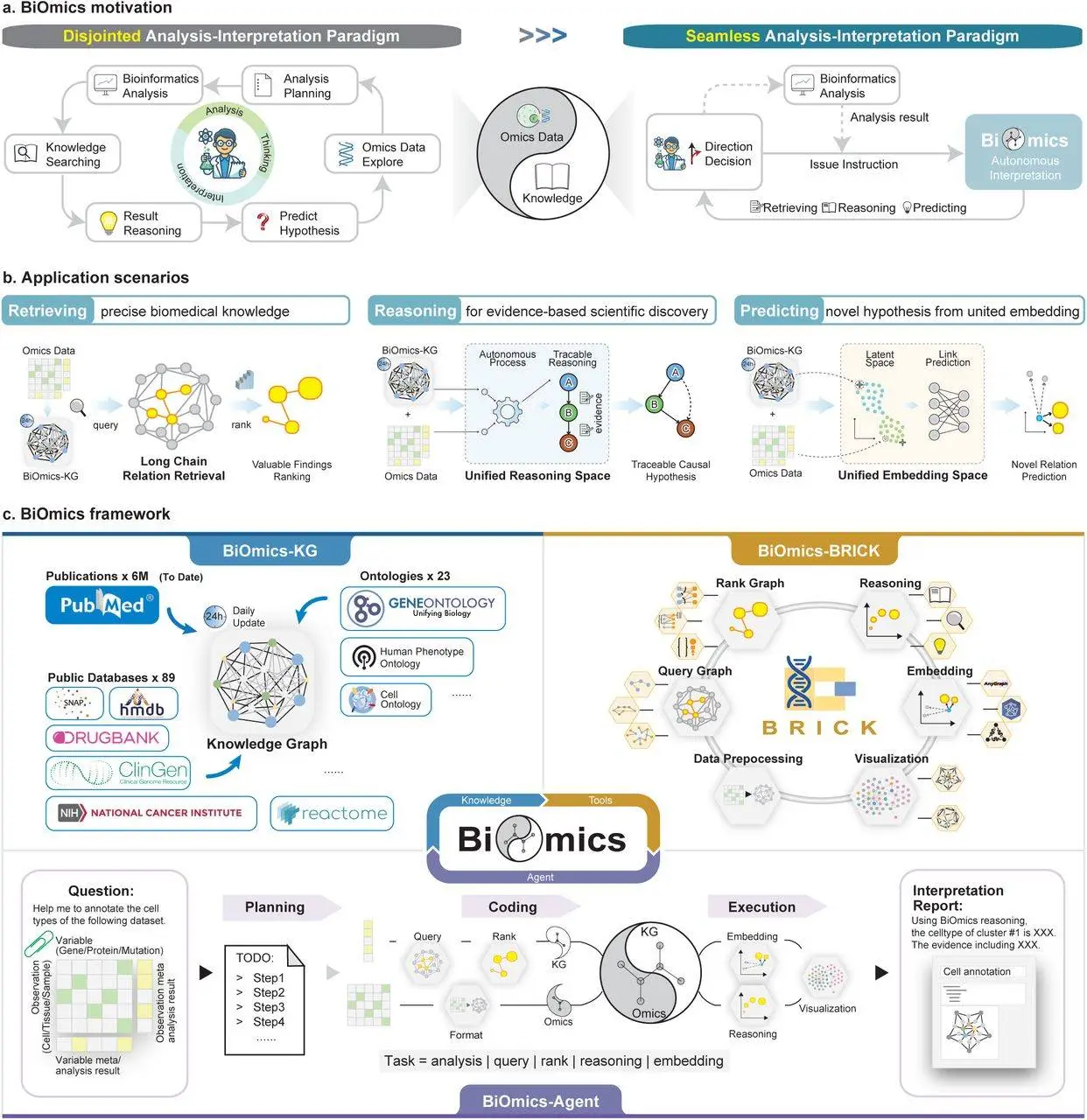
BiOmics tries to sit in the middle of all this, combining a knowledge graph, a toolkit, and a reasoning agent into one connected system.
How is the system put together?
The framework has three main components. The first is BiOmics-KG, a knowledge graph built from 23 major biological ontologies, 89 public databases, and roughly six million PubMed articles. It contains over 10 million nodes and more than 356 million relationships, and it updates itself daily by pulling in new literature automatically, without a human needing to curate it.
The second piece is BiOmics-BRICK, a toolkit made of six modules covering data preprocessing, querying the graph, ranking results, reasoning, embedding data into a shared representation, and visualization. Think of it as the operational layer that lets the system actually do things with both the omics data and the knowledge graph at the same time.
The third piece, BiOmics-Agent, is the part that ties everything together using large language models. It parses what the user is asking for, plans out an analysis, writes and runs code inside a sandboxed environment, and then compiles a report explaining what it found and why.
The core idea behind the design is what the researchers call a “Retrieving-Reasoning-Predicting” approach. First, the system retrieves grounded facts from the knowledge graph. Then it reasons through those facts in an explicit, traceable way to conclude. Finally, it uses a separate embedding space to predict associations that aren’t explicitly documented anywhere yet, essentially filling in gaps that the literature hasn’t caught up to.
What was it actually tested on?
The team ran BiOmics through a wide range of benchmarks and compared it against GPT-4o, a biomedical agent called Biomni, and several specialized bioinformatics tools. A few results stood out. In identifying disease-causing genetic variants from GWAS data related to type 2 diabetes, BiOmics didn’t just confirm known variants; it also flagged an insertion in a gene called ZNF536 that isn’t directly linked to diabetes in existing databases but appears to interact with a gene that is.
In single-cell analysis, BiOmics was able to annotate cell types without needing a reference dataset, outperforming existing reference-free tools by a solid margin, and it was even able to untangle two closely related pancreatic cell types that typical clustering methods tend to lump together.
For drug repurposing, tested on COVID-19 patient blood samples, the system correctly ranked known COVID-19 treatments like dexamethasone highly based on similarity in its learned embedding space, while also surfacing lesser-known candidates such as retinoic acid and paclitaxel as worth investigating further.
The bigger picture
What makes this approach interesting isn’t any single benchmark number; it’s the attempt to make AI-driven biology interpretable again. Instead of an answer with no explanation, BiOmics tries to give a reasoning chain that someone can actually check. The authors are upfront that the system still has limits: it hasn’t been systematically tested on metabolomics or epigenomics, and it still depends on LLM-generated code for some tasks, which can struggle with unusual edge cases.
Still, as a demonstration of coupling a live, self-updating knowledge base with an agent that can reason and predict across genomics, transcriptomics, and proteomics, BiOmics is a useful marker of where AI for biological discovery seems to be heading next.
Article Source: Reference Paper
Disclaimer:
The research discussed in this article was conducted and published by the authors of the referenced paper. CBIRT has no involvement in the research itself. This article is intended solely to raise awareness about recent developments and does not claim authorship or endorsement of the research.
Important Note: bioRxiv releases preprints that have not yet undergone peer review. As a result, it is important to note that these papers should not be considered conclusive evidence, nor should they be used to direct clinical practice or influence health-related behavior. It is also important to understand that the information presented in these papers is not yet considered established or confirmed.
Follow Us!
Learn More:

Anchal is a consulting scientific writing intern at CBIRT with a passion for bioinformatics and its miracles. She is pursuing an MTech in Bioinformatics from Delhi Technological University, Delhi. Through engaging prose, she invites readers to explore the captivating world of bioinformatics, showcasing its groundbreaking contributions to understanding the mysteries of life. Besides science, she enjoys reading and painting.