Molecular biology is currently undergoing a taxonomic reckoning. For decades, the human genome was defined by a stable, canonical figure: roughly 19,500 to 20,000 protein-coding genes. These established sequences form the bedrock of drug development and clinical diagnostics. However, a major collaborative effort is now proving that this “canonical” view is merely the tip of the iceberg.
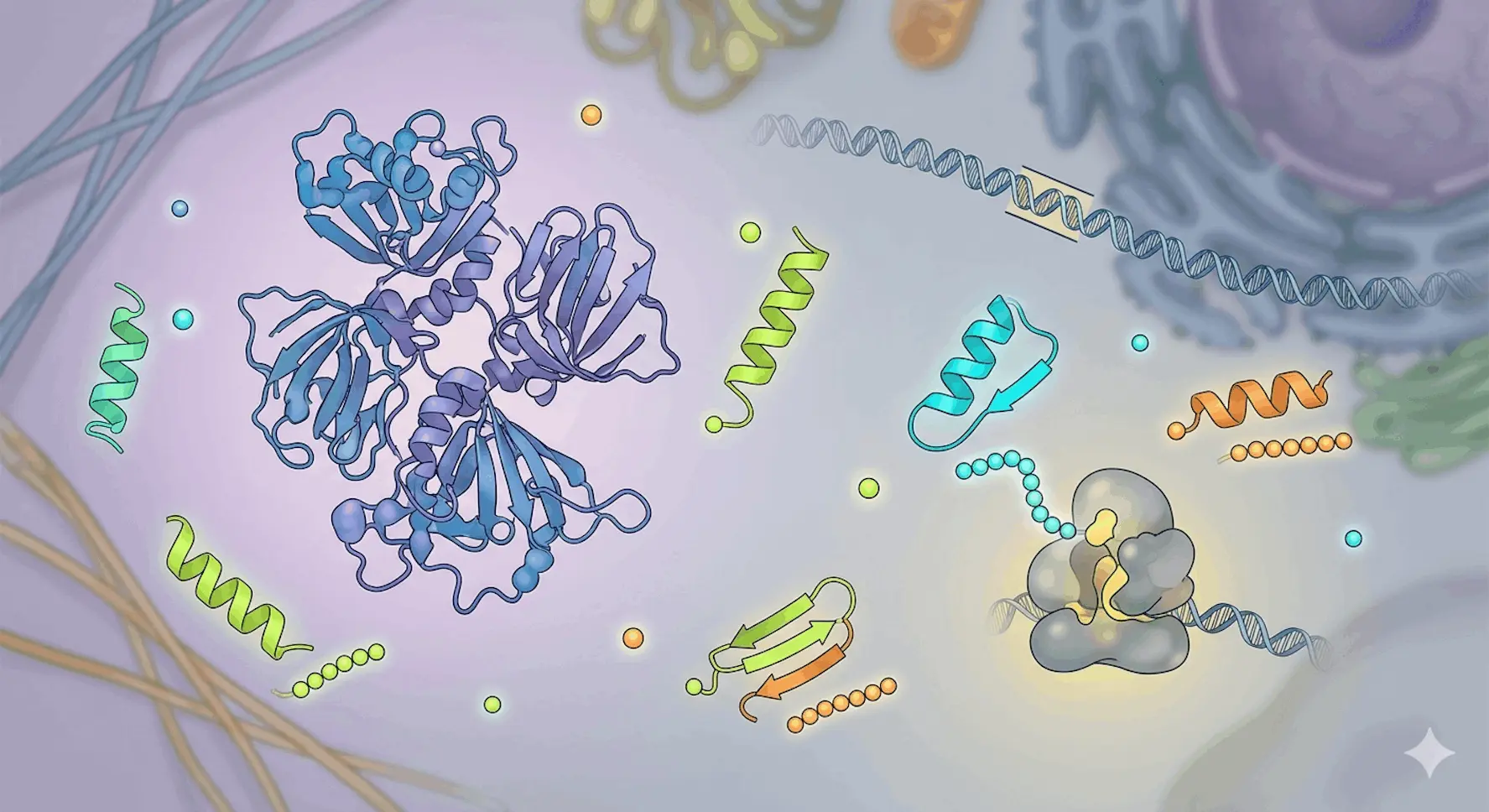
The emerging “dark proteome” consists of thousands of non-canonical open reading frames (ncORFs) that have long been invisible to official databases. To map this territory, the TransCODE Consortium—an international group including experts from GENCODE and PeptideAtlas—has launched a mission to standardize the discovery of these hidden molecules. Much like the reclassification of Pluto as a “dwarf planet,” these sequences were missed not because they weren’t there, but because they didn’t meet the arbitrary size and criteria constraints of traditional genomic filters. By expanding the human proteome, researchers are revealing a biological landscape far more complex than previously imagined.
Meet the ‘Peptidein’—Biology’s Newest Classification
The scientific community has reached a crossroads: how do we classify a molecule that is clearly being manufactured by the cell but whose precise biological purpose remains a mystery? To resolve this, the TransCODE Consortium introduced the “peptidein”—a clever portmanteau of peptide and protein. This classification provides a vital “waiting room” for molecules that exist endogenously but may be transient products of cellular stress or defective ribosome translation.
Peptidein: An open reading frame (ORF) with experimentally confirmed RNA translation and protein synthesis, but for which the data are currently insufficient to claim conventional protein-coding gene status.
In an analysis of 7,264 ncORF sequences, only 15 were promoted to “official” protein status, including the uoORF c11riboseqorf4 (found in the PIDD1 gene) and c12norep105 (within CYP27B1). Meanwhile, 121 sequences were initially classified as peptideins. This tier-based system allows scientists to acknowledge these molecules’ existence without prematurely assigning functional labels.
The HLA Breakthrough—Where These Hidden Proteins Hide
One of the most significant findings involves the “visibility” of these dark proteins. Standard proteomics often fails to detect microproteins because of a technical bottleneck: the “trypsin hurdle.” Most mass spectrometry relies on trypsin to digest proteins into fragments, but many microproteins are simply too small to produce the required two “tryptic” peptides of at least nine amino acids each.
However, by analyzing 95,520 proteomics experiments, researchers found that ~25% (1,785) of ncORFs appeared in Human Leukocyte Antigen (HLA) data. Immunopeptidomics bypasses the need for tryptic digestion because the cell’s own machinery processes these microproteins from the intracellular pool and presents them on the cell surface. This is a major breakthrough for cancer immunotherapy; these “cancer-restricted cryptic antigens” serve as specific, high-resolution targets for next-generation treatments that were previously invisible to standard screens.
ORBL—A New Yardstick for Evolutionary “ORFness”
Why were these sequences dismissed as “biological noise” for so long? Historically, they lacked the amino acid conservation signatures found in larger proteins. To solve this, researchers developed ORBL (ORF Relative Branch Length), which reveals an “evolutionary paradox.” While many ncORFs have low PhyloCSF scores (indicating low amino acid conservation), they show a startlingly high conservation of “ORFness.”
ORBL measures whether a reading frame consistently remains “open” across species—conserving the start codon, stop codon, and length—even if the specific amino acids vary. The data show that 30.4% of ncORFs exhibit significant evolutionary constraint (ORBLq > 0.9). These sequences are not random accidents; they have been maintained by natural selection for millions of years, suggesting they perform essential biological work that we have yet to categorize.
The Case of c10riboseqorf92—A Functional “Dark” Essential
To see the impact of peptideins in action, we must look at the OLMALINC transcript. Long classified as a non-coding RNA, OLMALINC was found to harbor a hidden 123-amino acid sequence known as c10riboseqorf92.
Functional genomics revealed this peptidein is “pan-essential” for cell survival. In CRISPR experiments across hundreds of cell lines, the loss of c10riboseqorf92 led to a total loss of cell viability, specifically linked to mitosis and DNA damage regulation. Hidden in plain sight on a transcript previously dismissed as “dark matter,” this essential peptidein proves that microproteins can hold critical, “protein-like” roles in human disease even before they are fully annotated in official catalogs.
Setting the Multi-Consortium Research Agenda
The TransCODE Consortium has established a forward-looking roadmap to integrate the dark proteome into mainstream science. This agenda focuses on three primary pillars:
- Updating Validation Standards: Re-evaluating HUPO-HPP guidelines that currently penalize microproteins for their small size.
- Contextual Annotation: Determining if proteins found exclusively in cancer cells or under extreme stress deserve the same status as those in normal physiology.
- AI and Structural Stability: Utilizing deep learning tools like AlphaFold and ESMFold to predict whether these microproteins form stable functional units or remain transient by-products.
Conclusion: The Future of the Human Proteome
The human proteome is no longer a static list of 20,000 items; it is a dynamic, expanding map. As consortium member Jonathan Mudge succinctly puts it: “It’s made of amino acids… we know it exists.” This shift marks the beginning of a new era where “hidden” players could be the keys to understanding orphan diseases and developing novel immunotherapies. For researchers ready to explore this new frontier, the data is now available through public tools at PeptideAtlas.
Article Source: Reference Paper | Reference Article
Disclaimer:
The research discussed in this article was conducted and published by the authors of the referenced paper. CBIRT has no involvement in the research itself. This article is intended solely to raise awareness about recent developments and does not claim authorship or endorsement of the research.
Follow Us!
Learn More:



Dr. Tamanna Anwar is a Scientist and Co-founder of the Centre of Bioinformatics Research and Technology (CBIRT). She is a passionate bioinformatics scientist and a visionary entrepreneur. Dr. Tamanna has worked as a Young Scientist at Jawaharlal Nehru University, New Delhi. She has also worked as a Postdoctoral Fellow at the University of Saskatchewan, Canada. She has several scientific research publications in high-impact research journals. Her latest endeavor is the development of a platform that acts as a one-stop solution for all bioinformatics related information as well as developing a bioinformatics news portal to report cutting-edge bioinformatics breakthroughs.