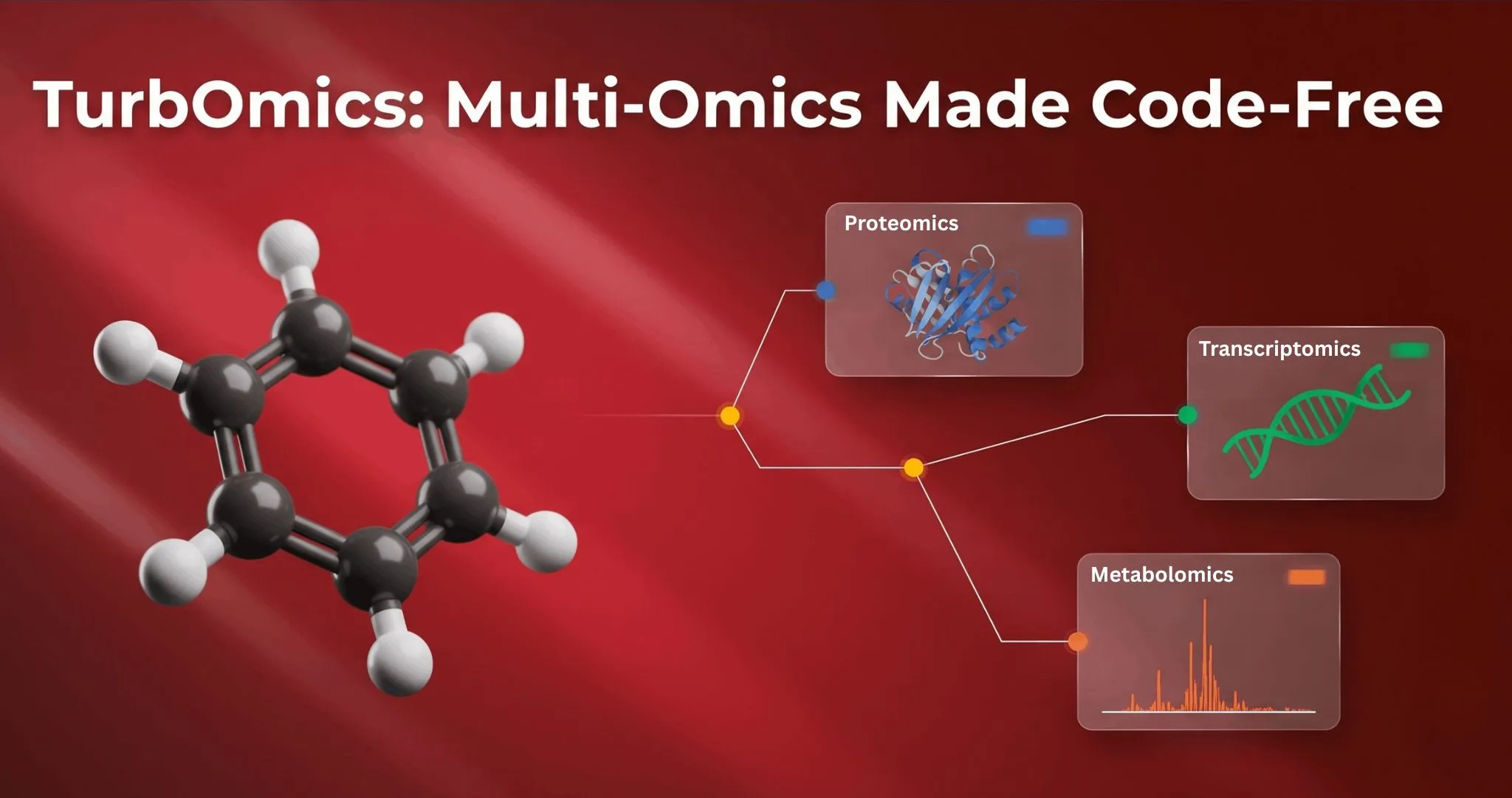
Researchers at the Centro Nacional de Investigaciones Cardiovasculares (CNIC) in Madrid, together with colleagues at the European Molecular Biology Laboratory (EMBL) in Heidelberg, have developed TurbOmics, a free web platform that lets scientists analyze metabolomics data alongside proteomics and transcriptomics without writing code. The tool is described in a Software article published in Genome Biology on 10 October 2026. The journal currently lists it as an early-access version.
Why metabolomics is the hardest layer to integrate
Combining several molecular layers from the same samples gives a fuller picture of a biological system than any single layer on its own. Metabolomics is especially valuable because metabolites sit close to the observable phenotype. However, the authors point out that many existing integration tools handle metabolomics poorly. This is especially true for untargeted experiments, where thousands of mass-spectrometry signals have no confirmed identity. Many tools also depend on predefined knowledge bases, and the more advanced statistical methods usually require programming skills and statistical expertise.
What TurbOmics does
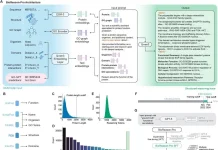
TurbOmics brings the main steps of a multi-omics analysis into one point-and-click interface:
- Data upload: simple tab-separated tables (sample metadata, feature metadata, and quantification matrices), or an R/Bioconductor MultiAssayExperiment object.
- Preprocessing: normalization, centering and scaling, and handling of missing values (filtering and imputation).
- Putative annotation of untargeted features: features are matched by mass (m/z) against public metabolite databases. The results are then refined with TurboPutative, an earlier tool from the same group, so that each feature keeps its most likely annotation.
- Exploratory analysis: distribution plots and principal component analysis (PCA) for each omics layer.
- Multi-Omics Factor Analysis (MOFA): finds shared sources of variation across layers, followed by over-representation analysis.
- Pathway integrative analysis and enrichment analysis (GSEA), including custom pathway sets and options designed for untargeted metabolomics.
All results are interactive and can be exported, and previous analyses can be reopened later using a job ID.
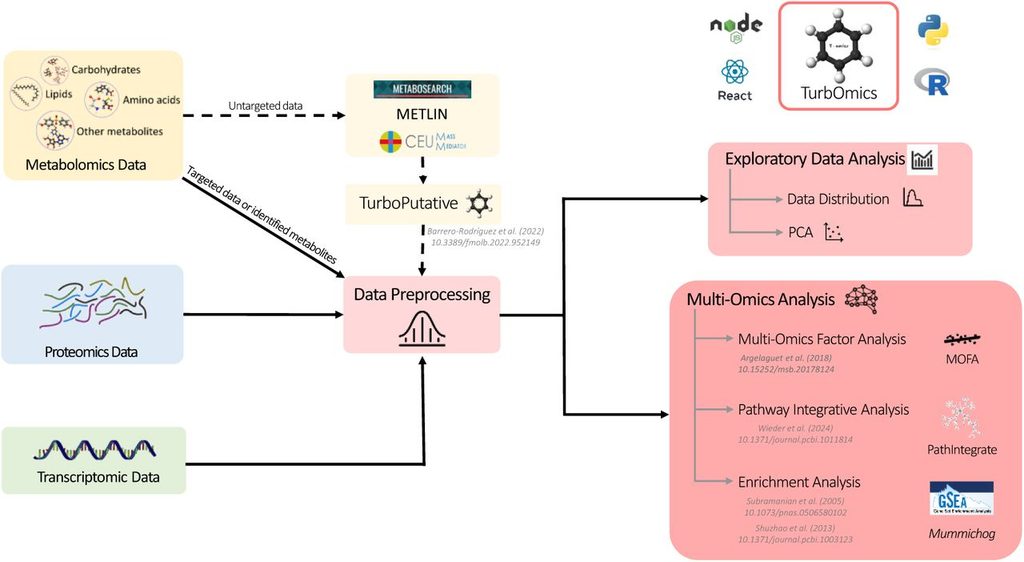
Image Source: https://proteomics.cnic.es/TurboPutative/home
Key terms in plain language
- Untargeted metabolomics: measuring every detectable small-molecule signal rather than a preselected list. It offers broad coverage, but many signals have uncertain identities.
- Putative annotation: a “best guess” identity for a signal, based on its mass and other evidence, but not yet confirmed.
- MOFA: a statistical method that summarises several omics datasets into a small number of “factors”, each capturing a pattern of variation that may be shared across layers.
Tested on two published datasets
The authors demonstrate TurbOmics on liver data from mice in an earlier CNIC atherosclerosis study (Lorenzo et al., Nature 2021). In the version of this work previously posted as a preprint on bioRxiv, the authors report that the platform recovered the lipid-metabolism changes seen in the original study. They also report that it highlighted additional lipid features that the original analysis had excluded with a stricter significance filter. In that analysis, TurbOmics flagged 37 decreased triglyceride features and 27 diglyceride features, compared with 13 and 3 in the original study.
The team also applied TurbOmics to plasma data from a published COVID-19 study (Su et al., Cell 2020), combining targeted metabolomics and proteomics from patients with mild, moderate, and severe disease alongside healthy controls. According to the preprint, the platform reproduced the two main patterns of variation reported in the original study, including rising inflammatory cytokines such as IL-6 and higher ceramide and sphingolipid levels in moderate-to-severe patients.
Practical takeaways for researchers
- Low barrier to entry: the platform is free and, according to the authors, requires no registration. It is designed for researchers without programming experience.
- Built for untargeted data: it is designed to work with uncertain annotations rather than discarding them.
- Reproducible: each analysis gets a job ID, and the developers provide a step-by-step tutorial that reproduces the paper’s case studies.
- Current scope: the platform works with transcriptomics, proteomics, and metabolomics. The preprint version notes that integration requires samples paired across the omics layers. The authors plan to add genomics and epigenomics in future versions.
Try it
Working with metabolomics alongside other omics data? TurbOmics is available at proteomics.cnic.es/TurboPutative/TurbOmicsApp.html. Tell us in the comments which multi-omics integration tools have worked best for your projects.
Source:
Barrero-Rodríguez, R., Rodríguez, J.M., Naake, T. et al. TurbOmics: a web-based platform for the analysis of metabolomics data using a multi-omics integrative approach. Genome Biol (2026). https://doi.org/10.1186/s13059-026-04272-y.
Preprint: https://doi.org/10.1101/2025.05.09.653072
Disclaimer:
The research discussed in this article was conducted and published by the authors of the referenced paper. CBIRT has no involvement in the research itself. This article is intended solely to raise awareness about recent developments and does not claim authorship or endorsement of the research.
Follow Us!
Learn More:



Dr. Tamanna Anwar is a Scientist and Co-founder of the Centre of Bioinformatics Research and Technology (CBIRT). She is a passionate bioinformatics scientist and a visionary entrepreneur. Dr. Tamanna has worked as a Young Scientist at Jawaharlal Nehru University, New Delhi. She has also worked as a Postdoctoral Fellow at the University of Saskatchewan, Canada. She has several scientific research publications in high-impact research journals. Her latest endeavor is the development of a platform that acts as a one-stop solution for all bioinformatics related information as well as developing a bioinformatics news portal to report cutting-edge bioinformatics breakthroughs.