GlucoFM: Google’s New Foundation Model Reads Glucose Data Like a Language
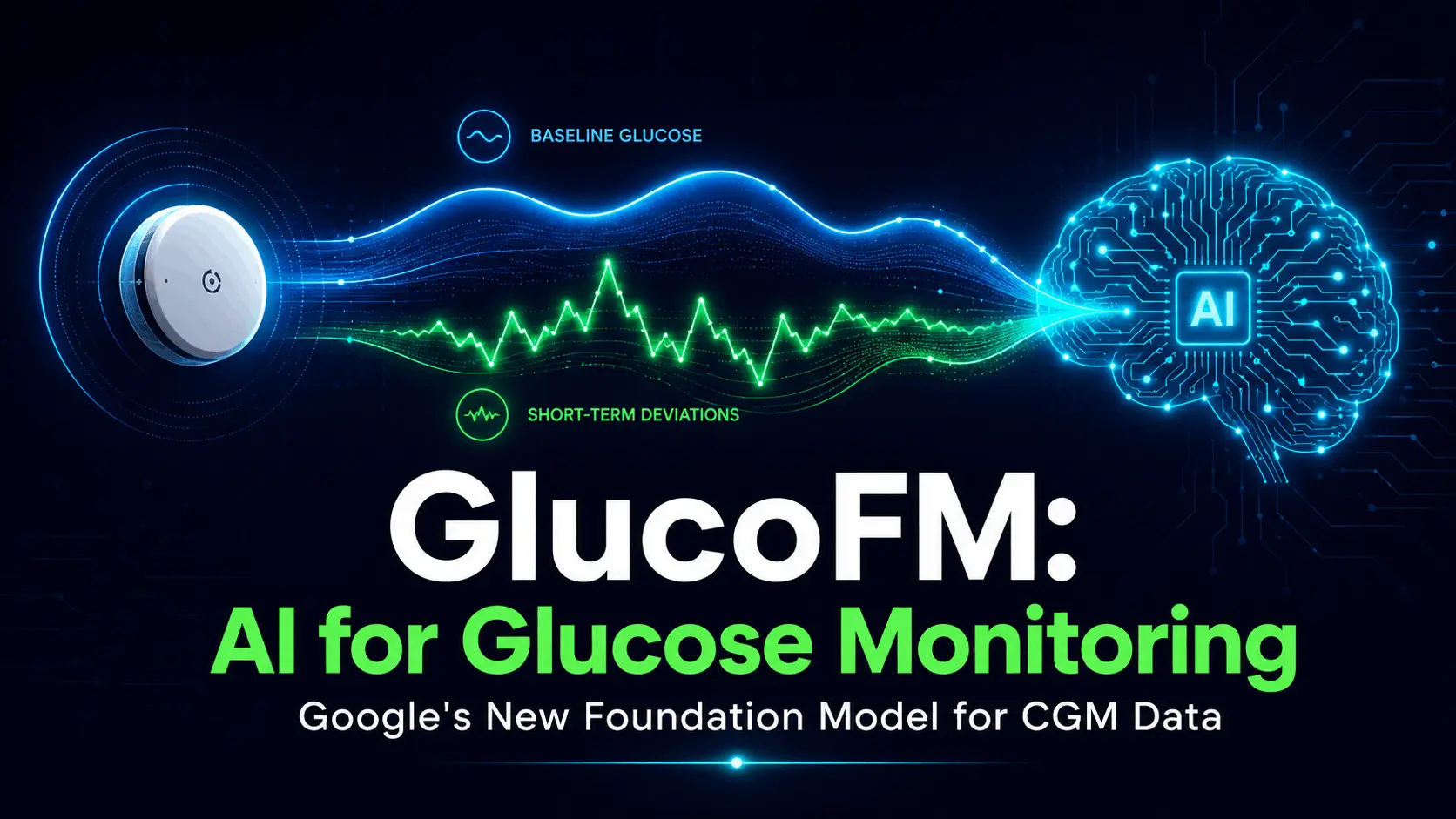
Wearables have gotten remarkably good at estimating how much we move and how well we sleep. But glucose regulation — the hidden machinery behind metabolic health — doesn’t show up directly in motion or heart-rate data. It needs its own signal. That’s where continuous glucose monitors (CGMs) come in, tracking interstitial glucose every few minutes through a small under-the-skin sensor, capturing fasting, overnight, and post-meal patterns in fine detail.
The problem isn’t collecting this data — it’s making sense of it. High-quality clinical labels that help interpret CGM traces are sparse and expensive to obtain, which limits how much can be learned from any single study.
GlucoFM, newly announced by Google Research in collaboration with the University of New South Wales, is an attempt to close that gap.. It’s a lightweight, self-supervised foundation model built specifically for CGM data, and according to the researchers, it sets new performance benchmarks across a range of metabolic prediction tasks — from diabetes risk to post-meal glucose response.
Why CGM Needs Its Own Kind of Model
A handful of CGM foundation models already exist — among them are CGMformer, GluFormer, and CGM-JEPA. According to the researchers, these models share a common design choice: they process glucose readings through a single representation stream, treating the signal as one continuous, undifferentiated trace.
But glucose data isn’t really uniform. It contains slow-moving baseline patterns — the kind that shift gradually across a day — punctuated by short, sharp deviations tied to meals, physical activity, or even sensor artifacts. The team’s central bet with GlucoFM was that explicitly separating these two kinds of dynamics, rather than blending them into one stream, would produce more useful representations for downstream clinical prediction.
Inside GlucoFM: A Dual-Stream Design
GlucoFM’s architecture splits incoming glucose data into two parallel streams:
A state stream, capturing slower glycemic trends — the steady baseline drift of blood sugar over hours.
An event stream, capturing short-term deviations that may reflect a meal, a workout, or a sensor hiccup.
To train the model without relying on scarce clinical labels, the researchers used latent-prediction pre-training rather than trying to reconstruct exact raw glucose values (which are prone to sensor noise). Two objectives drive this:
Contextual prediction — parts of a daily glucose sequence are masked, and the model learns to predict their latent representations from the surrounding context, capturing broader daily patterns rather than memorizing individual readings.
Temporal dynamics — the model learns how a person’s baseline and short-term deviations evolve from one hour to the next, encouraging it to treat glucose as a continuous process rather than a series of disconnected snapshots.
The team also applied CGM-specific data augmentations — simulating baseline drift, compression-like drops, sparser sampling, and short disconnections — to expose the model to the kind of messiness real-world sensors produce.
GlucoFM was pre-trained on 109,066 hours of unlabeled CGM data, drawn from Google’s Wear-CGM study and four published datasets, totaling 477 participant/session records.
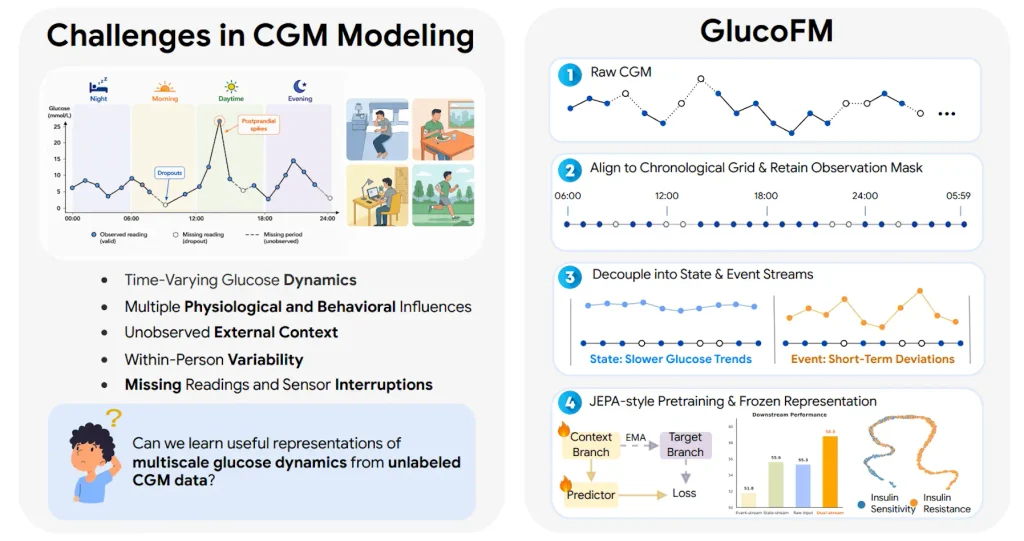
Image Source: https://doi.org/10.48550/arXiv.2605.30865
What the Results Show
The researchers evaluated GlucoFM across four cohorts — CGMacros, Stanford, Hall, and ShanghaiT2DM — spanning seven clinical prediction tasks, plus a separate assessment of post-meal glucose response. Across all 14 cohort-task evaluations, GlucoFM’s PR-AUC was 5.8 percentage points higher on average than the best-performing GluFormer variant, one of the leading existing CGM foundation models.
Metabolic phenotyping. Using subject-disjoint linear probing (freezing the model’s encoder and training a simple classifier on top, with no overlap between training and test participants), GlucoFM’s task-averaged PR-AUC rose from 54.7 for the strongest retrained baseline to 58.8 — a 4.1-point absolute gain, or roughly 7.5% relative improvement. It posted the top score across every diabetes-risk and beta-cell-dysfunction evaluation, and in three of four insulin-resistance evaluations.
Postprandial glucose response. Using one hour of pre-meal CGM data plus meal nutrition and participant-level information, GlucoFM achieved the lowest mean absolute error (MAE) among tested models — 21.88 mg/dL, compared with 22.90 mg/dL for the best baseline and 27.69 mg/dL for a simple mean-based baseline.
Multiple days of data. Combining representations across up to seven days generally improved prediction accuracy by as much as 9.6 points for beta-cell dysfunction in the Stanford cohort and 14.0 points for diabetes prediction in the Hall cohort. Notably, this wasn’t universal: insulin resistance prediction in the ShanghaiT2DM cohort didn’t benefit from simple day-averaging, suggesting the best way to combine multi-day data may depend on the task.
Cross-cohort transfer. When a classifier trained on one cohort was tested on a completely different one, GlucoFM outperformed the strongest competing method in 11 of 12 evaluations — by margins of 0.5 to 8.6 PR-AUC points — and trailed in just one case, by 0.6 points.
Few-shot learning. Even with as few as one labeled participant per class, or just 1% of available observations, GlucoFM’s representations outperformed competing models — evidence, the researchers argue, that it’s efficient at extracting useful signal from very limited labeled data.
Architecture ablation. The researchers also tested simplified versions of the model — one using raw glucose values directly, one emphasizing only the slow state stream, and one emphasizing only the fast event stream. The event-only variant performed worst, but none of the simplified versions matched the full dual-stream model, which outperformed all three alternatives.
Why This Matters — and Where the Caution Signs Are
The value proposition here is real, provided the numbers hold up under further scrutiny: pre-trained, reusable representations that reduce how much labeled clinical data is needed to build accurate metabolic prediction models.
A few caveats are worth keeping in view. This work is currently a preprint and doesn’t yet appear to have completed independent peer review. The researchers themselves note that their pre-training population remains modest, and all reported results are retrospective, drawn from four curated research cohorts rather than live clinical use. The researchers stated next steps reflect these gaps directly: training on larger and more diverse populations, moving toward native multi-day modeling rather than independently processed 24-hour windows, and exploring how the model adapts to real-time changes in glucose patterns.
The Takeaway
GlucoFM is a highly motivated architecture that considers glucose to be made up of two different entities instead of one, and it has been validated on the basis of a pretty decent set of benchmarking tests related to the risk of developing diabetes, insulin resistance, beta cell dysfunction, and postprandial glucose prediction. GlucoFM consistently outperformed prior CGM foundation models across most tested cohorts and tasks, though not universally — it trailed the top competing model in 1 of 12 cross-cohort transfer evaluations. What remains to be seen is whether it performs better when applied to larger samples and independent testing.
Article Source: Reference Paper | Reference Article
Disclaimer:
The research discussed in this article was conducted and published by the authors of the referenced paper. CBIRT has no involvement in the research itself. This article is intended solely to raise awareness about recent developments and does not claim authorship or endorsement of the research.
Important Note: arXiv releases preprints that have not yet undergone peer review. As a result, it is important to note that these papers should not be considered conclusive evidence, nor should they be used to direct clinical practice or influence health-related behavior. It is also important to understand that the information presented in these papers is not yet considered established or confirmed.
Follow Us!
Learn More: