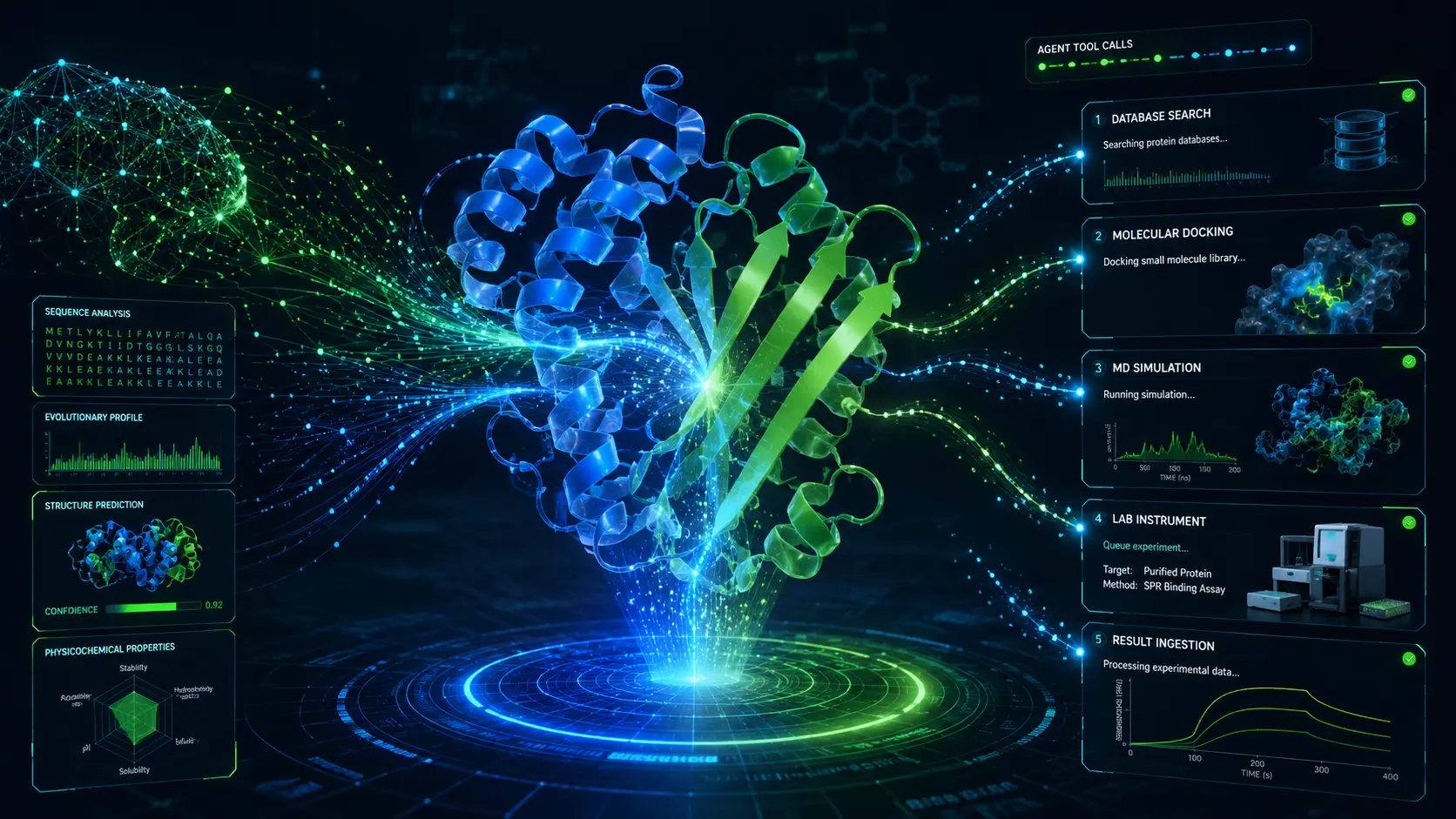
NVIDIA launched the BioNeMo Agent Toolkit, a set of AI-ready tools that lets AI agents act like scientists by enabling them to choose models, reason across workflows, and execute environments using BioNeMo Skills to run full scientific workflows in pharma, biotech startups, and labs.
AI agents are becoming powerful research assistants in the life sciences, capable of reading scientific papers, analyzing data, writing code, and helping researchers test hypotheses. However, NVIDIA emphasizes that drug discovery is complex, iterative, and driven by real-world experiments—not just code. Unlike software development, scientific research requires context-aware reasoning and specialized tools. To address this, NVIDIA developed the BioNeMo Agent Toolkit, enabling AI agents to support real biological research better.
A Brief Introduction To BioNeMo Agent Toolkit
A general-purpose agent might know that protein folding is a relevant concept. But it doesn’t know which specific model to call (AlphaFold or OpenFold) or how to interpret the result in a scientific context.
NVIDIA’s BioNeMo is presented here as a toolbox for scientists, providing domain-specific tools for biology (OpenFold, DiffDock), chemistry (MoIMIM, GenMol), and genomics (Evo2, Geneformer), wrapped as BioNeMo Skills and packaged with documented resources so agents can call them like functions in a workflow.
BioNeMo Skills are the operational layer that makes the idea of AI scientists effective by correctly calling models, interpreting outputs, and iterating toward discovery.
While the entire framework of BioNeMo Agent Toolkit makes the tools agent-callable, it combines BioNeMo with Nemotron, NemoClaw, and NIM microservices. This toolkit lets you build an AI scientist that can reason, call BioNeMo Skills, and run workflows end-to-end.
“Frontier models are the brains. BioNeMo is the scientific toolbox. Together, they give AI agents the skills of a PhD research assistant and the speed of a supercomputer.”
- Jensen Huang, the Founder and CEO of NVIDIA, says in NVIDIA’s official announcement of the BioNeMo Toolkit.
Components of BioNeMo Agent Toolkit
- Nemotron Open Models: The reasoning engine that helps AI agents understand scientific problems and plan workflows.
- NeMo RL Library: Enables agents to improve through trial and error by learning from feedback.
- NeMoClaw Blueprints: Securely connects multiple tools into complete scientific workflows.
- BioNeMo Skills: Domain-specific capabilities that let agents perform specialized biology tasks.
- OpenShell Runtime: A secure environment where agents execute code, analyses, and pipelines.
Rather than relying on code alone, scientific discovery requires reasoning and the right tools. NVIDIA’s BioNeMo Agent Toolkit combines both, enabling AI agents to carry out real biological research workflows.
Hands-on Mechanics of Appointing Yourself With an AI Agent
Step 1: Plan the Workflow
Define the scientific goal, choose the right AI model, prepare inputs, run analyses, evaluate outputs, and interpret results. BioNeMo Skills and NVIDIA NIM simplify this process.
Step 2: Explore the BioNeMo Platform
Let the agent discover available tools in the BioNeMo Agent Toolkit before selecting the best capability for the task.
Step 3: Choose a Deployment Option
Use NIM Endpoints for easy, managed access or Local NIM for faster, GPU-powered iterative workflows with greater control.
Step 4: Run Models with BioNeMo Skills
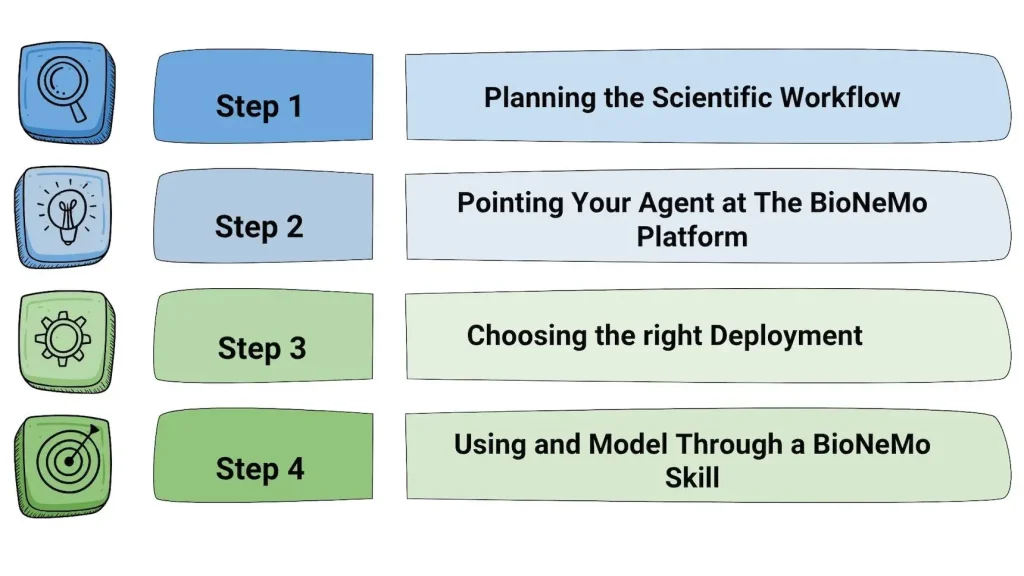
BioNeMo Skills provide a consistent interface across models, allowing agents to switch between them seamlessly.
Efficiency of BioNeMo Agent Toolkit: Benchmark Results
Benchmarks show that, with BioNeMo Agent Toolkit, agents show a 2X improvement in efficiency compared to agents without Skills. NVIDIA tested the benchmarks using Codex CLI with GPT-5.5 fast. Results proved that agents averaged 2x more passing assertions per token consumed. Skills being ‘agent-agnostic’, similar improvements are expected with other backends and models.
Without Skills:
- Agents waste tokens figuring out how to call models/ format inputs/ or interpret outputs
- Produce invalid requests
- Misinterpret artifacts
With Skills:
- The agent directly calls the model correctly, reducing trial and error
- Iterative loops become streamlined
Further Integrations
The blog published in Dassault Systèmes by Leo Bleicher, Director of Biosciences and Scientific Informatics, argues that drug design already has many existing techniques, and the current challenge is not how to invent newer ones, but to execute the right method in the right context.
According to the author, reducing friction in the process of choosing and implementing the correct method is where the next big value lies, and so BioNeMo’s Agent Toolkit is actively integrated into BIOVIA’S MARIE virtual scientific chatbot that interacts in natural language and connects scientists to the right tools at the right time.
Conclusion
The BioNeMo Agent Toolkit from NVIDIA allows AI agents to carry out end-to-end science workflows by integrating reasoning, biomolecular work, accelerated computing, and controlled execution. The modular skills of BioNeMo allow agents to carry out experiments, analyze the data, and understand their meaning through one common interface.
Article Source: Reference Article | Availability: GitHub
Disclaimer:
The research discussed in this article was conducted and published by the authors of the referenced paper. CBIRT has no involvement in the research itself. This article is intended solely to raise awareness about recent developments and does not claim authorship or endorsement of the research.
Important Note: The article is available on the company’s website and has not yet undergone peer review. As a result, it is important to note that these papers/articles should not be considered conclusive evidence, nor should they be used to direct clinical practice or influence health-related behavior.
Follow Us!
Learn More:

Saniya is a graduating Chemistry student at Amity University Mumbai with a strong interest in computational chemistry, cheminformatics, and AI/ML applications in healthcare. She aspires to pursue a career as a researcher, computational chemist, or AI/ML engineer. Through her writing, she aims to make complex scientific concepts accessible to a broad audience and support informed decision-making in healthcare.