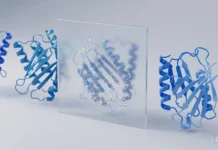
Researchers at the University of Washington, the Allen Institute for AI (Ai2), the National University of Singapore, and the Howard Hughes Medical Institute have developed Prompteina, an AI model that generates complete, all-atom protein structures from natural-language descriptions. Instead of setting up a separate technical input for every design goal, a scientist can simply describe the protein they want, from its fold and secondary structure to how it should bind a target.
Why Describe a Protein in Words?
Most generative protein-design tools are steered by narrow, property-specific inputs: a target fold here, a hotspot residue there. Each new kind of constraint usually needs its own conditioning method. The team drew inspiration from text-to-image generators. If language can describe almost any picture, it might also work as a single, flexible interface for describing protein structure and function.
How Prompteina Works
The researchers first assembled Prompteina-Data, a training set of roughly 1.8 million protein structures paired with more than 50 million text captions covering both whole-protein and residue-level properties.
They then adapted Proteina-Complexa, an existing pretrained structure-generation model from NVIDIA, so that it accepts text. According to the project’s GitHub page, training ran in four stages: warming up a new text module while the underlying model stayed frozen, continued pretraining, alignment fine-tuning, and a final stage on protein pairs for binder design. Prompts are interpreted by two frozen Qwen3 language-model encoders.
Prompts can specify:
- Fold and topology, such as CATH class and architecture
- Secondary-structure counts and sheet topology
- Tertiary motifs such as disulfide bonds and salt bridges
- Overall size, shape, symmetry and flexibility
- Surface and binding-interface properties
- Function, such as a protein family or activity
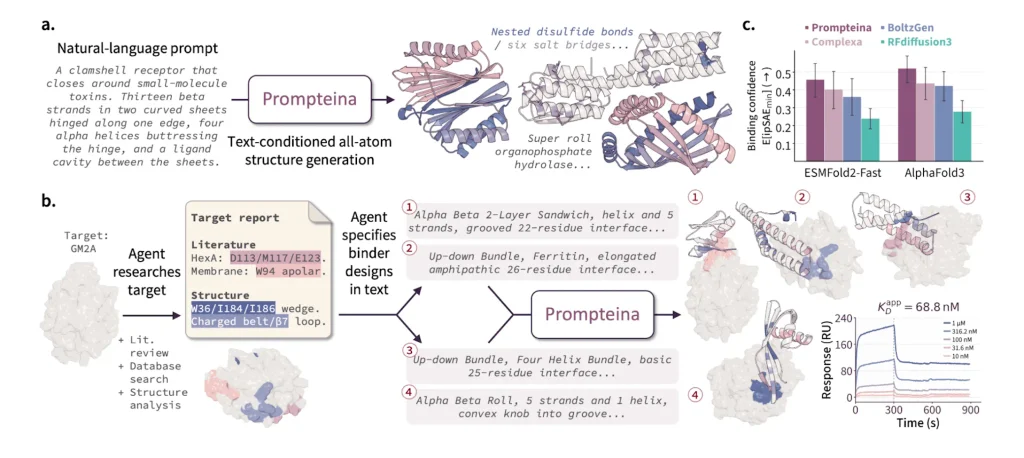
Image Source: Lee, J., et al. W. (2026).
Key Terms in Plain Language
- All-atom structure: a 3D model that places every atom, including side chains, not just the protein backbone.
- Binder: a protein designed to attach to a chosen target molecule, a common starting point for therapeutics, diagnostics and research reagents.
- De novo design: building a protein from scratch rather than modifying a natural one.
- K_D (dissociation constant): a measure of binding strength; lower values mean tighter binding.
What the Results Show
In computational benchmarks, Prompteina outperformed baseline methods on 15 of 18 structural properties. For binder design, it led on at least 13 of 20 targets and reached 14% higher interface confidence than the strongest baseline. Adding iterative in silico feedback, where designs are refined over repeated computational rounds, widened its lead on the hardest targets.
The team also tested designs in the lab against GM2A, a protein linked to the rare disorder GM2 gangliosidosis and a target with no previously reported de novo binders. Of 90 designs tested, nine bound the target, the strongest with an apparent K_D of 107 nM.
Practical Takeaways for Researchers
- Open release: code is available under Apache 2.0 and model weights are on Hugging Face under the NVIDIA Open Model License. The project README says the training dataset is being prepared for public release.
- Hardware: the two text encoders alone need about 32 GB of GPU memory, and setup requires Python 3.12 and CUDA 12.6.
- Getting started: example prompts for monomer and binder design are included, along with an agent workflow that researches a target and drafts design specifications.
- Read with care: lab validation so far covers a single target, and the benchmarks have not yet been through peer review.
The Bigger Picture
Prompteina suggests that natural language could become a general control panel for protein design, letting researchers combine many constraints in one request and opening the door to AI agents that run design campaigns. Peer review and testing on more targets will show how far the approach generalizes.
Exploring generative protein design in your own work? Follow CBIRT for daily coverage of the latest advances in bioinformatics and computational biology.
Reference: Lee, J., Li, Y., Qiang, B., Lau, G., Ettinger, A., Smith, N. A., Donovan-Maiye, R., Baker, D., Hajishirzi, H., & Koh, P. W. (2026). Designing Protein Structures from Natural Language. arXiv preprint arXiv:2610.13917. https://doi.org/10.48550/arXiv.2610.13917
Disclaimer:
The research discussed in this article was conducted and published by the authors of the referenced paper. CBIRT has no involvement in the research itself. This article is intended solely to raise awareness about recent developments and does not claim authorship or endorsement of the research.
Important Note: arXiv releases preprints that have not yet undergone peer review. As a result, it is important to note that these papers should not be considered conclusive evidence, nor should they be used to direct clinical practice or influence health-related behavior. It is also important to understand that the information presented in these papers is not yet considered established or confirmed.
Follow Us!

Dr. Tamanna Anwar is a Scientist and Co-founder of the Centre of Bioinformatics Research and Technology (CBIRT). She is a passionate bioinformatics scientist and a visionary entrepreneur. Dr. Tamanna has worked as a Young Scientist at Jawaharlal Nehru University, New Delhi. She has also worked as a Postdoctoral Fellow at the University of Saskatchewan, Canada. She has several scientific research publications in high-impact research journals. Her latest endeavor is the development of a platform that acts as a one-stop solution for all bioinformatics related information as well as developing a bioinformatics news portal to report cutting-edge bioinformatics breakthroughs.