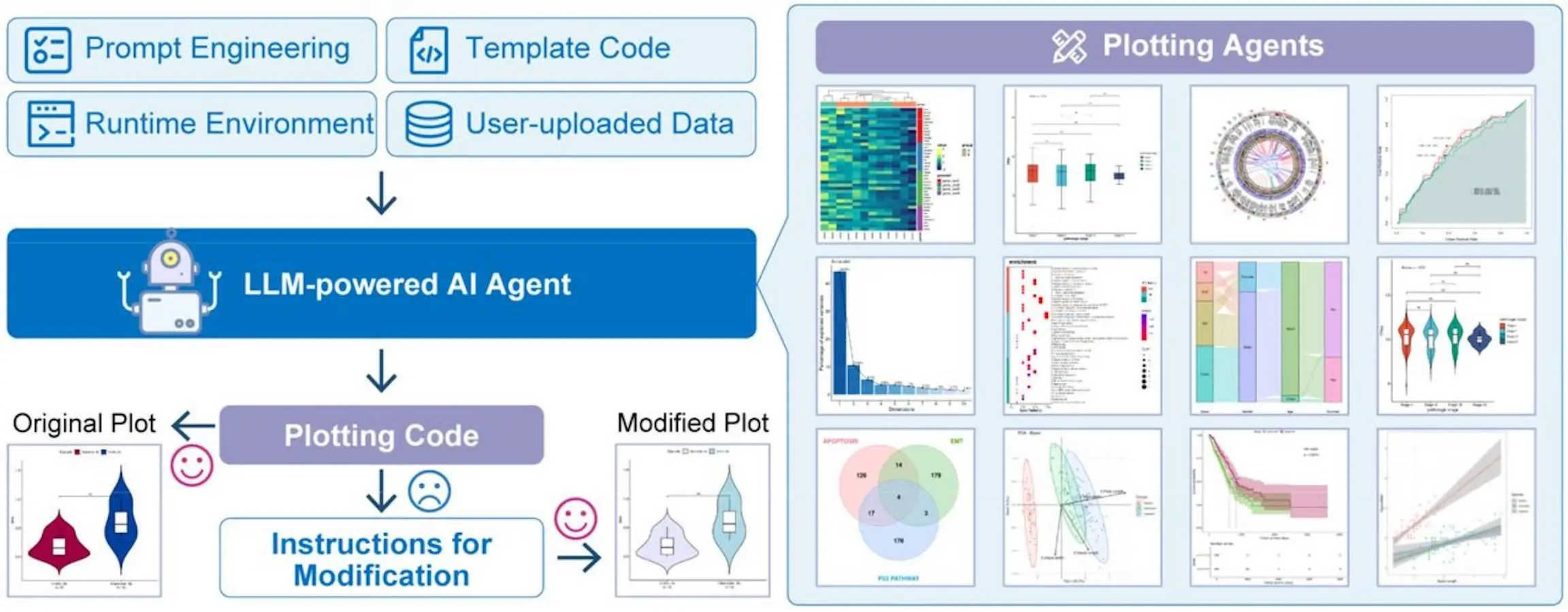
The research team affiliated with Sun Yat Sen University in Guangzhou engineered PlotGDP, an AI-based web server tool designed to assist people with various bioinformatics plotting tasks, with no coding or environment deployment required.
Biomedical research catalyzes progress in medicine, diagnostics, and therapies. Thousands of papers are published on a daily basis across journals. Without the advent of bioinformatics as research’s backbone, much of today’s massive biomedical data would remain unanalyzed or misinterpreted, making data analysis one of the most important tasks of research.
Even small errors in plotting data can cause serious controversy. Some papers have been criticized for using misleading scales, exaggerating effects, or leading to paper retractions, which damages the credibility of the researchers.
PlotGDP Solves Challenges in Visualization: Case Study in Cancer Research
Just as in any other research, cancer research also produces enormous datasets that include gene expression levels, mutations, patient survival, etc. To understand the pattern behind these, scientists rely heavily on visualizations. Considering how vulnerable errors in plotting patterns in these datasets are, testing PlotGDP is a bold step for scientists.
The researchers used real cancer biology datasets such as TCGA (The Cancer Genome Atlas), then PlotGDP was asked to create visualizations that are standard in cancer research, such as:
- Survival curves (Kaplan-Meier plots): These show how long patients live after diagnosis or treatment
- Gene expression plots: Charts showing how active certain genes are in cancer versus normal tissue.
The testing proved that PlotGDP could generate publication-ready plots directly from cancer datasets. It can handle complex requests that combine multiple data types, reducing the barrier for researchers who aren’t coding experts, so they can focus on interpreting results rather than struggling.
Key Gaps In Data Plotting Encountered By Researchers
Plotting datasets in research is far more complex than it looks. It’s not just about laying out a graph, but about translating complex, multidimensional data into a clear, accurate, publication-ready chart. The major challenges faced by researchers when plotting data are due to the following reasons:
- Data-related challenges: Datasets generated by multi-omics and imaging often involve thousands of variables, over hundreds of scales, like genes, proteins, samples, etc. Such datasets are of high dimensionality, and analyzing results into a single figure is as challenging as it sounds. Data may also come from multiple sources, requiring collaboration between informaticians, data scientists, and researchers for plotting.
- Scalability: Biological measurements span over several orders of magnitude and have lots of experimental noise, incomplete entries complicating visualization even more.
- Technical Barriers: Most of the plotting relies on the R programming language (ggplot2), Python (matplotlib, seaborn, plotly), or a specialized library that requires knowledge of coding. Small coding errors can lead to misleading plots.
- Statistical & Ethical Errors: Using incorrect scales, axes, or inappropriate statistical plots can distort findings, especially for small datasets.
- Designing the plots: Journals demand figures that are not only accurate but aesthetically polished, which requires careful formatting.
These are the challenges tools like PlotGDP aim to solve. The team has a track record in building accessible visualization tools. They have already built Domain Graph (DOG), IBS, IBS 2.0, and BioGDP, which were user-friendly and widely adopted, but they are primarily designed for illustrations and cannot generate plots from raw data. Even LLM agents similar to PlotGDP, like GWO2R, GEPIA, etc., only support a narrow range of plots, so they cannot be used for different types of multi-omics research. Newer integrated tools like SRplot and BioLadder are expensive, creating barriers for researchers in resource-limited settings.
Conclusion
PlotGDP supports 14 common plot types, such as heatmaps, volcano plots, PCA biplots, and others, while also providing users with example datasets, parameter explanations, and debugging support. It allows researchers to generate publication-ready plots through simple commands without the need for coding expertise or understanding of complex setups. The case study on breast cancer research has also proven PlotGDP’s ability to identify and analyze differentially expressed genes, highlighting its potential to speed up biomedical discoveries.
Article Source: Reference Paper | PlotGDP is available at the web server.
Disclaimer:
The research discussed in this article was conducted and published by the authors of the referenced paper. CBIRT has no involvement in the research itself. This article is intended solely to raise awareness about recent developments and does not claim authorship or endorsement of the research.
Important Note: bioRxiv releases preprints that have not yet undergone peer review. As a result, it is important to note that these papers should not be considered conclusive evidence, nor should they be used to direct clinical practice or influence health-related behavior. It is also important to understand that the information presented in these papers is not yet considered established or confirmed.
Follow Us!
Learn More:




Saniya is a graduating Chemistry student at Amity University Mumbai with a strong interest in computational chemistry, cheminformatics, and AI/ML applications in healthcare. She aspires to pursue a career as a researcher, computational chemist, or AI/ML engineer. Through her writing, she aims to make complex scientific concepts accessible to a broad audience and support informed decision-making in healthcare.