Conventional molecular dynamics (MD) simulations provide atomistic insights into molecular behavior but are fundamentally limited by their femtosecond time steps, making it computationally challenging to capture the slow conformational changes and relaxation processes that drive chemical and biological functions. Addressing this longstanding challenge, researchers at Chalmers University of Technology and the University of Gothenburg in Sweden have developed a deep generative modeling framework, “TITO,” that accelerates molecular dynamics simulations by up to 10,000-fold while preserving atomistic accuracy.
Published in the journal Science Advances, the study represents a significant advance in computational molecular science, enabling accurate characterization of equilibrium ensembles and long-timescale molecular dynamics in small molecules and peptides. The approach opens new opportunities for exploring conformational landscapes, thermodynamics, and kinetics in systems central to chemistry and biophysics.
The Problem: Molecules Move Too Fast and Too Slow at the Same Time
To figure out how a drug molecule behaves, how it folds, how it binds to a target, and how stable it is, scientists rely on molecular dynamics (MD) simulations. These simulations track every atom and calculate the forces acting on it, moving everything forward in tiny time increments of about one femtosecond (that’s 10⁻¹⁵ seconds).
The problem is that the biological processes we actually care about- protein folding, conformational changes, a drug detaching from its target- happen on timescales of microseconds to seconds. To bridge that gap using femtosecond steps, you need billions upon billions of calculations. Even with supercomputers, this becomes painfully slow and expensive, which is part of why drug development takes so long and costs so much.
Enter TITO: Teaching AI the “Rules” of Molecular Motion
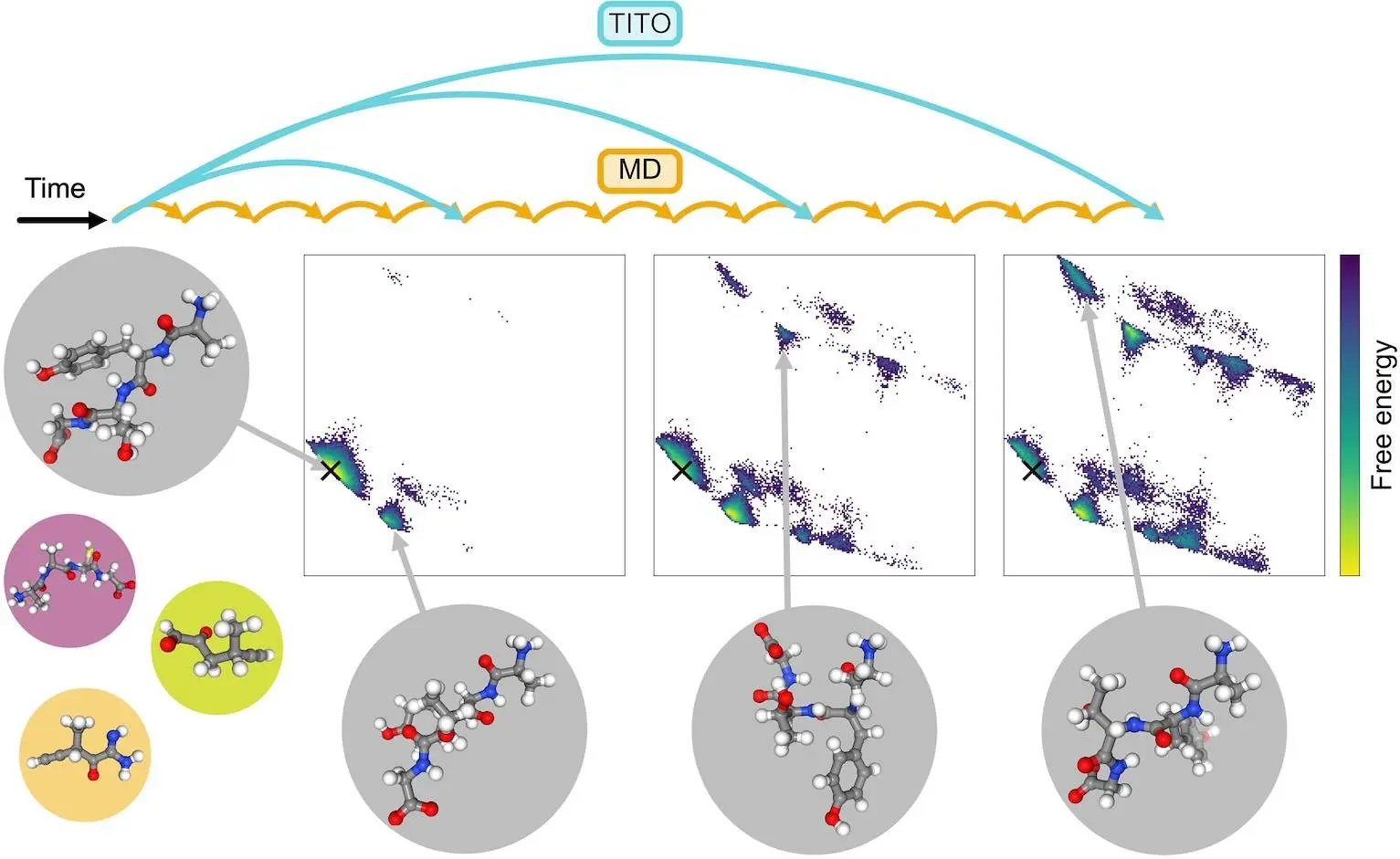
The researchers’ solution is a new AI framework called TITO, short for Transferable Implicit Transfer Operators. Instead of grinding through every single femtosecond step, TITO learns the underlying statistical rules that govern how molecules evolve, and then it can jump straight ahead to where a molecule would be much later, skipping all the steps in between.
Think of it like watching a movie. Traditional simulation is like watching every single frame, one by one, even during the boring parts. TITO instead learns to predict what a much later scene will look like, based on patterns it picked up from earlier footage, without needing to render every frame in between.
What makes TITO stand out is that it doesn’t just predict static snapshots of molecular shapes. It also captures the dynamics: how quickly transitions happen and which pathways molecules take to get from one state to another. According to the authors, this combination of speed, accuracy, and genuine dynamical insight hadn’t been demonstrated across such a wide range of molecules before.
How Big Is the Speedup?
TITO can accelerate simulations by up to four orders of magnitude; that’s up to 15,000 times faster in some cases, while still producing results consistent with the laws of physics. On a single high-end GPU running for one day, TITO can simulate roughly 10 milliseconds of physical molecular behavior, compared to just a few microseconds using conventional methods on the same hardware. That’s a four-orders-of-magnitude jump in throughput.
Tested on Thousands of Molecules
To make sure TITO wasn’t just a one-trick model that memorized a handful of examples, the team trained and tested it on a huge and diverse dataset: over 12,500 small organic molecules containing carbon, nitrogen, hydrogen, and oxygen, plus more than a thousand short peptides (small chains of amino acids that make up proteins).
Crucially, TITO was tested on molecules it had never seen during training, and it still performed well. The researchers compared its predictions against results from traditional, brute-force simulations and found they lined up closely, both in terms of the shapes molecules adopt and the speed at which they transition between those shapes.
In one notable example involving a molecule called propiolamide, TITO actually uncovered a hidden, stable molecular state that long conventional simulations had completely missed, and this finding was later confirmed using other independent simulation methods. In other words, TITO wasn’t just faster; it was sometimes more thorough.
The team even pushed TITO beyond its training data, asking it to predict the behavior of peptides twice the size of anything it had trained on. While accuracy understandably dropped a bit at these larger sizes, the model still produced results that were qualitatively realistic, a promising sign for future scaling.
What This Means for Drug Discovery
So why should anyone outside a chemistry lab care about this? Because drug discovery is, at its core, a massive screening problem. Thousands of candidate molecules need to be tested computationally before the most promising few move on to expensive lab and clinical testing. Anything that makes those early computational screens faster and more accurate can shave significant time and cost off the entire pipeline.
As Simon Olsson, the study’s research leader, put it, the goal is to help researchers figure out what’s likely to happen in a molecule’s “future”, predicting how it will behave over timescales a thousand times longer than what the model was actually trained on.
A Step, Not the Finish Line
The current version works with implicit solvent models, is limited to systems of a few hundred atoms, and operates at a single temperature and pressure. The researchers are already working on extending it to more complex, realistic systems, including ones that better represent real biological environments.
Still, this work represents a genuinely new direction for AI in chemistry, one that doesn’t just generate plausible molecular shapes, but actually learns how molecules move and change over time. If that capability scales up as hoped, it could become a valuable tool for pharmaceutical researchers hunting for the next breakthrough drug, helping them spend less time waiting on simulations and more time on the molecules that actually matter.
Article Source: Reference Paper | Reference Article | Code Availablity: GitHub
Disclaimer:
The research discussed in this article was conducted and published by the authors of the referenced paper. CBIRT has no involvement in the research itself. This article is intended solely to raise awareness about recent developments and does not claim authorship or endorsement of the research.
Follow Us!
Learn More:



Anchal is a consulting scientific writing intern at CBIRT with a passion for bioinformatics and its miracles. She is pursuing an MTech in Bioinformatics from Delhi Technological University, Delhi. Through engaging prose, she invites readers to explore the captivating world of bioinformatics, showcasing its groundbreaking contributions to understanding the mysteries of life. Besides science, she enjoys reading and painting.