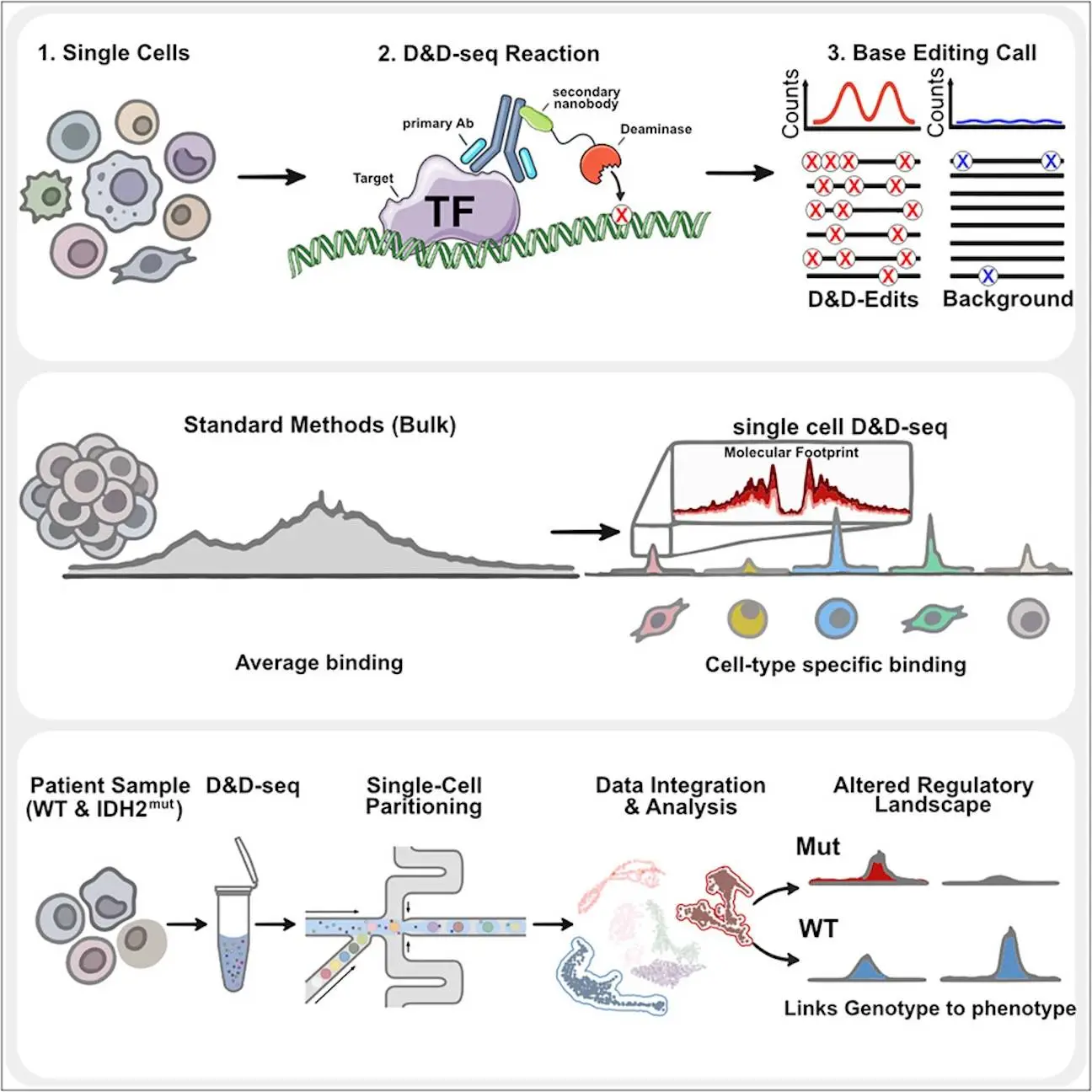
If you’ve ever tried to figure out exactly where a transcription factor sits down on the genome inside a single cell, you know it’s one of those problems that sounds simple but has quietly resisted easy solutions for years. A new paper out in Cell from a team of researchers at Weill Cornell Medicine and the New York Genome Center takes a solid swing at this problem with a method they call D&D-seq, short for “docking and deamination followed by sequencing.”
I’ll be honest: the name doesn’t roll off the tongue, but the idea behind it is genuinely clever, and its implications range from basic chromatin biology to understanding how cancer-associated mutations rewire gene regulation.
Why is this even a problem
Transcription factors (TFs) and chromatin remodelers are the proteins that decide which genes get switched on or off in a given cell. Mapping where they bind across the genome tells you a lot about how cells maintain their identity, respond to signals, or go wrong in disease. The classic tools for this, ChIP-seq and its newer cousin CUT&Tag, work reasonably well in bulk, but they start to struggle when you want single-cell resolution, especially for proteins that bind weakly or only briefly.
Part of the issue is technical: most of these methods rely on tethering a DNA-cutting enzyme (often Tn5 transposase) to an antibody-bound protein, and then fragmenting nearby DNA. But Tn5 needs high-salt conditions to behave itself, and those same salty conditions tend to wash away the weak or short-lived protein-DNA interactions you’re trying to capture in the first place. So you end up with a tool that’s great for abundant, sticky proteins like histones, but not so great for the more dynamic regulatory factors that are often the most biologically interesting.
The D&D-seq trick
Instead of cutting DNA, the Cornell/NYGC team decided to edit it. They engineered a fusion protein that links a nanobody (a tiny antibody fragment that recognizes the primary antibody bound to your protein of interest) to a split version of DddA, a bacterial enzyme that converts cytosine bases into uracil. Crucially, the enzyme is built in two pieces that only become active when brought together — so it stays “off” until it’s properly docked near the target protein, then gets switched “on” with a small activating peptide and a bit of zinc.
The result is that wherever the target protein is sitting on the DNA, nearby cytosines get quietly converted to uracils, leaving a chemical “breadcrumb trail” that shows up later as C-to-T changes when the DNA is sequenced. Because this doesn’t require harsh tagmentation conditions, even fleeting interactions leave a detectable mark.
What makes this especially practical is that the whole reaction can be layered onto standard ATAC-seq workflows, including single-cell ATAC-seq, whole-genome sequencing, and 10x Genomics Multiome kits, without much extra fuss.
What they actually showed
The team first validated the approach in bulk experiments on K562 cells, mapping CTCF, GATA1, and GATA2 binding and showing strong overlap with established ENCODE ChIP-seq data. They then pushed into single cells, mixing two different cell lines and showing that D&D-seq could correctly assign CTCF or GATA1 signals to the right cell population, basically proving the method doesn’t bleed signal across cell types.
From there, things get more ambitious. In primary human blood cells (PBMCs), they mapped CTCF binding across all the major immune cell subtypes and even used the resulting data to feed a machine-learning model (C.Origami) that predicts 3D genome folding, getting results comparable to those obtained using full ChIP-seq datasets.
Perhaps the most striking application combines D&D-seq with single-cell genotyping in a sample from a patient with clonal hematopoiesis carrying an IDH2 mutation. By simultaneously reading out a cell’s genotype, its chromatin accessibility, and its CTCF binding pattern, the researchers could directly compare mutant and normal cells from the same person. They found that IDH2-mutant CD8 T cells had measurably weaker CTCF binding, consistent with the known link between this mutation, DNA hypermethylation, and disrupted genome architecture, and they could see how this translated into reshaped 3D chromatin structure around specific genes like GIT1.
Why it matters
D&D-seq still only captures a relatively small number of editing events per cell, so it works best when you pool information across many cells (pseudobulk or “metacell” analyses) rather than trying to interpret any single cell in isolation. They also note that signal intensity at one site within a sample can’t be directly compared to a different site, since accessibility, antibody efficiency, and editing kinetics all factor in.
Still, this is the first time anyone has shown a motif- and ChIP-independent way to map TF binding at single-cell resolution that plugs into existing multi-omic pipelines. Given that transcription factors are increasingly being explored as drug targets, having a scalable way to ask “is this regulator actually bound here, in this specific cell, with this specific mutation” feels like exactly the kind of foundational tool that quietly enables a lot of downstream discovery. The Landau and Raimondi labs are reportedly already training other groups in the technique and working toward commercializing it — so don’t be surprised if D&D-seq starts showing up in more papers soon.
Article Source: Reference Paper | Reference Article | GitHub
Disclaimer:
The research discussed in this article was conducted and published by the authors of the referenced paper. CBIRT has no involvement in the research itself. This article is intended solely to raise awareness about recent developments and does not claim authorship or endorsement of the research.
Follow Us!
Learn More:



Anchal is a consulting scientific writing intern at CBIRT with a passion for bioinformatics and its miracles. She is pursuing an MTech in Bioinformatics from Delhi Technological University, Delhi. Through engaging prose, she invites readers to explore the captivating world of bioinformatics, showcasing its groundbreaking contributions to understanding the mysteries of life. Besides science, she enjoys reading and painting.