Every second, thousands of proteins inside your cells are bumping into each other, forming fleeting partnerships, and splitting apart again. These protein-protein interactions (PPIs) are the invisible handshakes that keep your heart beating, your immune system fighting, and your DNA replicating. Get them wrong, and disease follows.
But here’s the problem: figuring out which proteins actually interact with each other, out of potentially hundreds of thousands of possible pairings, has always been brutally hard. A new study from Fox Chase Cancer Center, Philadelphia, and others proposes a smarter way to do it. Their tool, PPIscreenML, was published in eLife and is already turning heads in the structural biology community.
The Old Ways, and Their Limits
For decades, scientists relied on experimental methods like yeast two-hybrid assays or affinity purification to discover which proteins interact. These techniques work, but they’re slow, expensive, and surprisingly error-prone; one analysis found that capturing 65% of true protein interactions required running ten separate assays. That’s a lot of work, with a lot of room for false positives and false negatives sneaking through.
Then came AlphaFold2 (AF2), the AI-based protein structure prediction tool that took the biology world by storm. AF2 can build remarkably accurate 3D models of proteins, and importantly, it can also model two proteins docked together, giving researchers a structural snapshot of a potential interaction. The catch? AF2 will happily build a model of any two proteins you throw at it, whether they actually interact in biology or not. It doesn’t tell you whether a pairing is real.
Existing scoring tools like iPTM and pDockQ were borrowed from model quality assessment and repurposed (somewhat awkwardly) for this classification task. Neither was designed for it, and neither performed particularly well on realistic benchmarks.
Building a Smarter Classifier
The team behind PPIscreenML started by asking a deceptively simple question: what does a “real” protein-protein interaction look like in a structural model, versus a convincing fake?
To answer it, they assembled 1,481 real, experimentally confirmed heterodimeric protein complexes from the DockGround database, structures where we already know two proteins bind each other. They filtered these carefully to avoid redundancy, keeping only complexes with less than 30% sequence identity between proteins.
Then they did something clever to build the “fake” examples, or decoys. For each real complex, they found the closest structural lookalike for each partner protein and swapped them in, creating new pairings of proteins that structurally resemble true interactions but almost certainly don’t interact in real life. This forced their classifier to find subtle, meaningful signals rather than just recognizing obvious structural nonsense.
Five AF2 models were built for each real and decoy complex, over 14,000 structural models in total. From each model, they extracted 57 numerical features: AF2 confidence scores, structural properties of the interface, and energy terms from the Rosetta molecular modeling software.
Seven standard machine learning algorithms were tested. XGBoost, a gradient-boosted decision tree method, came out on top with an AUC (area under the ROC curve) of 0.924 during validation. The team then trimmed the model down to just 7 features using sequential backward selection, a process of iteratively removing the least important features, without sacrificing performance. The final model achieved an AUC of 0.884 on a completely held-out test set.
How It Compares
When tested head-to-head against iPTM and pDockQ on the same dataset, PPIscreenML clearly won. Its AUC of 0.884 beat iPTM’s 0.843 and pDockQ’s 0.710. More visually telling was the score distribution: PPIscreenML pushed real interactions toward scores near 1 and fake ones toward 0, with a clean gap between them. The competing methods produced a messy, overlapping distribution, exactly what you don’t want when you’re trying to make confident decisions.
A Real-World Test: The TNF Superfamily
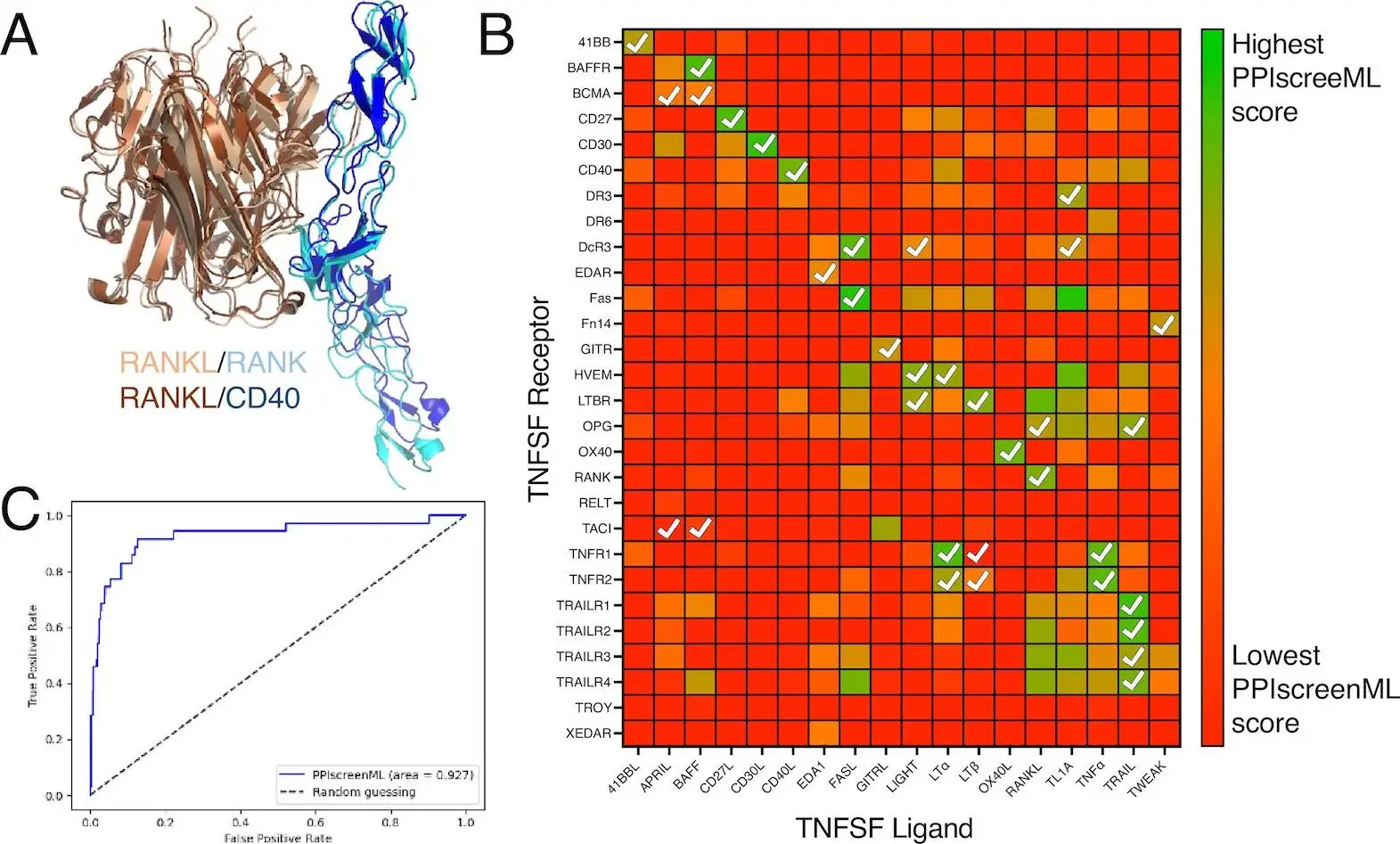
The team gave PPIscreenML a genuinely challenging real-world test. The tumor necrosis factor superfamily (TNFSF) contains 18 ligands and 28 receptors; that’s 504 possible pairings, but only 36 are known to actually engage each other. And all the proteins in this family share a similar structural fold, making decoy discrimination especially difficult.
PPIscreenML was never trained on any TNFSF proteins. Yet when applied to all 504 pairings, it achieved an AUC of 0.93, even better than on its own test set. For 14 of the 18 ligands, the top-scoring receptor was a confirmed true binding partner. This kind of generalization to unseen protein families is the real proof of a robust model.
Why This Matters
Mapping protein interaction networks has enormous implications, from understanding how diseases develop to designing drugs that can selectively disrupt or reinforce specific protein partnerships. PPIscreenML offers a computationally accessible, rigorously benchmarked tool that can slot directly into AF2-based screening workflows.
All the code, models, and structures are freely available on GitHub, meaning any lab with computational access can start using it today.
As AF2 itself continues to improve, the authors note that PPIscreenML’s performance should only get better alongside it; the main bottleneck now isn’t distinguishing real from fake interfaces, but simply getting AF2 to build accurate models for every protein pair in the first place. That’s a problem the field is actively solving.
Article Source: Reference Paper
Disclaimer:
The research discussed in this article was conducted and published by the authors of the referenced paper. CBIRT has no involvement in the research itself. This article is intended solely to raise awareness about recent developments and does not claim authorship or endorsement of the research.
Follow Us!
Learn More:



Anchal is a consulting scientific writing intern at CBIRT with a passion for bioinformatics and its miracles. She is pursuing an MTech in Bioinformatics from Delhi Technological University, Delhi. Through engaging prose, she invites readers to explore the captivating world of bioinformatics, showcasing its groundbreaking contributions to understanding the mysteries of life. Besides science, she enjoys reading and painting.