Proteins are remarkable molecules. They fold, bend, bind, and catalyze, all while balancing an internal tension that most biology textbooks barely mention. That tension has a name: local energetic frustration. And a new study from researchers at Helmholtz Munich, the Technical University of Munich, and the Barcelona Supercomputing Center has just made it dramatically easier to study at scale. Their tool, FrustrAI-Seq, can predict local energetic frustration for every residue in an entire proteome in under 20 minutes, using only the protein’s amino acid sequence as input. That’s a genuinely big deal.
What Is Energetic Frustration, and Why Should You Care?
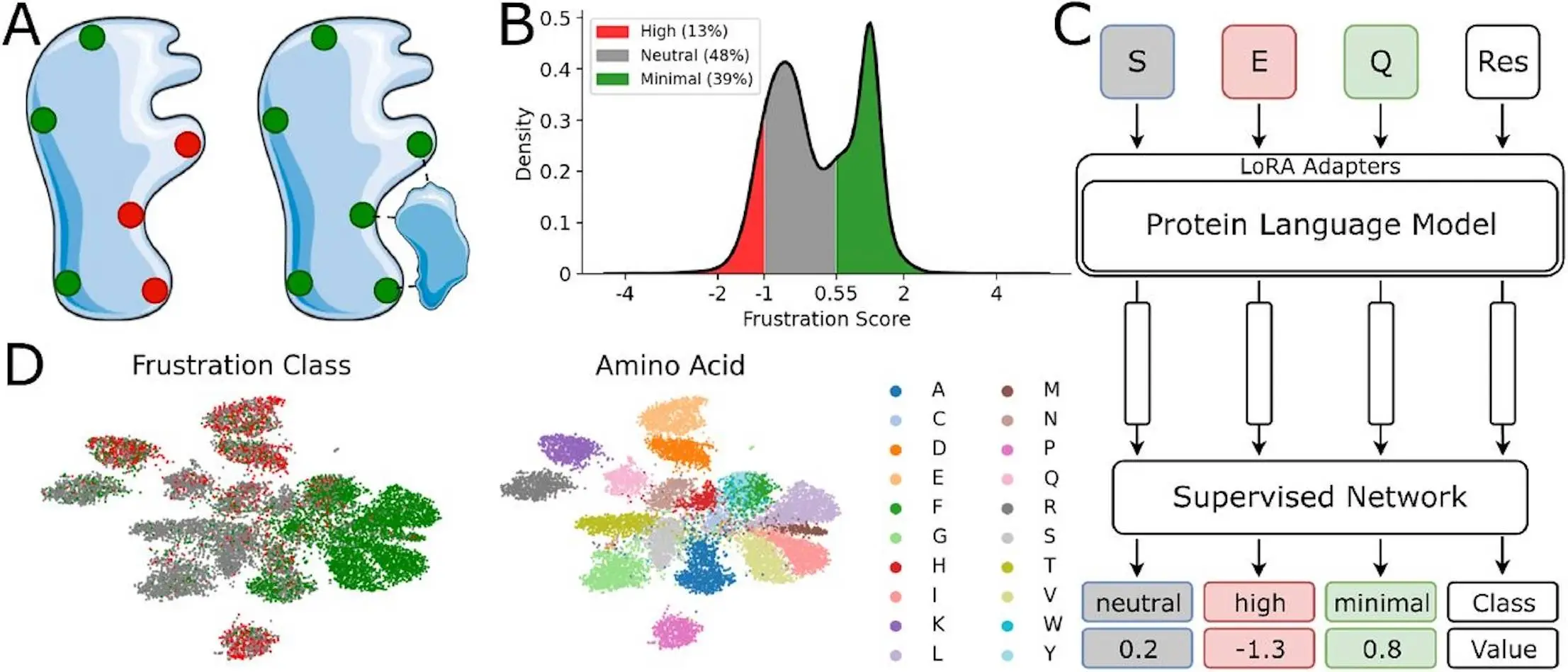
When a protein folds, it doesn’t perfectly optimize every single contact between its amino acids. Some residues end up in energetically unfavorable configurations, stuck in a kind of molecular compromise. These positions are called highly frustrated, and rather than being random imperfections, they tend to cluster around functionally important sites: active sites of enzymes, allosteric hotspots, protein-protein interaction interfaces. Evolution, it seems, has deliberately maintained a degree of internal tension because that tension enables function.
The classic way to measure this is through a tool called the Frustratometer, which compares a residue’s native energy against a distribution of structural decoys to compute a frustration index. The problem is that this calculation requires a 3D protein structure, which means either having an experimental structure or running AlphaFold first, and even then, running the Frustratometer across millions of proteins becomes computationally prohibitive.
What FrustrAI-Seq Actually Does
FrustrAI-Seq sidesteps the structure requirement entirely. The model takes a raw protein sequence, feeds it through ProtT5, a protein language model pre-trained on billions of sequences, and then passes those embeddings through a lightweight convolutional neural network that outputs both a continuous frustration score and a discrete class (highly frustrated, neutral, or minimally frustrated) for every residue.
The key innovation here is the fine-tuning strategy. The authors used LoRA (low-rank adaptation) to efficiently update ProtT5 on a custom dataset they assembled called the Funstration dataset, which contains pre-computed frustration values for nearly one million proteins spanning 8,259 functional protein families from the CATH database. Building this dataset alone was a substantial undertaking; it covers 186 million residues and represents, by the authors’ account, the largest freely available frustration resource ever compiled.
On a held-out test set with protein topologies the model had never encountered, FrustrAI-Seq achieved a Pearson correlation of 0.86 with structure-based Frustratometer scores and a macro F1 of 0.75 across the three frustration classes. For highly frustrated residues specifically, the minority class at just 13% of all residues, the recall was 0.84, which matters enormously because those are exactly the residues most tightly linked to function and disease.
Testing It on Real Biology
The authors didn’t stop at benchmarks. They applied FrustrAI-Seq to the α-globin protein family and compared its predictions against the FrustraEvo tool, which computes frustration conservation across multiple sequence alignments. The agreement was strong, particularly at conserved, minimally frustrated positions. More striking, the model correctly flagged a highly frustrated asparagine in guinea pig α-globin at a position where every other family member carries a neutral serine, catching a subtle, functionally relevant signal from sequence alone.
They also tested it on β-lactamases, a well-characterized enzyme family, by systematically introducing every possible single amino acid substitution at six catalytic residues. The correlation between FrustrAI-Seq’s predicted frustration changes and those computed by the Frustratometer ranged from 0.70 to 0.97, depending on the site, with lysine residues showing near-perfect agreement.
Proteome-Scale and What It Revealed
Running FrustrAI-Seq across 26 reference proteomes spanning bacteria, archaea, fungi, plants, and animals, the authors found a consistent pattern: proteomes with more intrinsically disordered proteins tend to carry a higher proportion of neutrally frustrated residues. Halobacterium salinarum, an extremophile adapted to high-salt environments, showed the highest proportion of highly frustrated residues across the entire dataset, a result that aligns with what we might expect from an organism whose proteins operate under constant environmental stress.
The entire human proteome took roughly 17 minutes on a single Nvidia H100 GPU. That number is worth sitting with for a moment, because structure-based approaches applied at the same scale would require orders of magnitude more compute.
The Bigger Picture
FrustrAI-Seq doesn’t replace the Frustratometer. The authors are clear about that. Structure-based calculations remain more accurate for individual proteins, especially when conformational dynamics matter. What FrustrAI-Seq offers is breadth, the ability to ask frustration-related questions about intrinsically disordered regions, newly designed proteins, and entire kingdoms of life, all without waiting for structural data. The model weights, training code, and the Funstration dataset are freely available, which should lower the barrier considerably for groups who want to integrate frustration analysis into their own pipelines.
There’s something quietly satisfying about a study that takes a concept as nuanced as energetic frustration and makes it accessible at the scale of the protein universe. The language of proteins, it turns out, carries more information about their internal physics than we previously knew how to read.
Article Source: Reference Paper | GitHub
Disclaimer:
The research discussed in this article was conducted and published by the authors of the referenced paper. CBIRT has no involvement in the research itself. This article is intended solely to raise awareness about recent developments and does not claim authorship or endorsement of the research.
Important Note: bioRxiv releases preprints that have not yet undergone peer review. As a result, it is important to note that these papers should not be considered conclusive evidence, nor should they be used to direct clinical practice or influence health-related behavior. It is also important to understand that the information presented in these papers is not yet considered established or confirmed.
Follow Us!
Learn More:




Anchal is a consulting scientific writing intern at CBIRT with a passion for bioinformatics and its miracles. She is pursuing an MTech in Bioinformatics from Delhi Technological University, Delhi. Through engaging prose, she invites readers to explore the captivating world of bioinformatics, showcasing its groundbreaking contributions to understanding the mysteries of life. Besides science, she enjoys reading and painting.