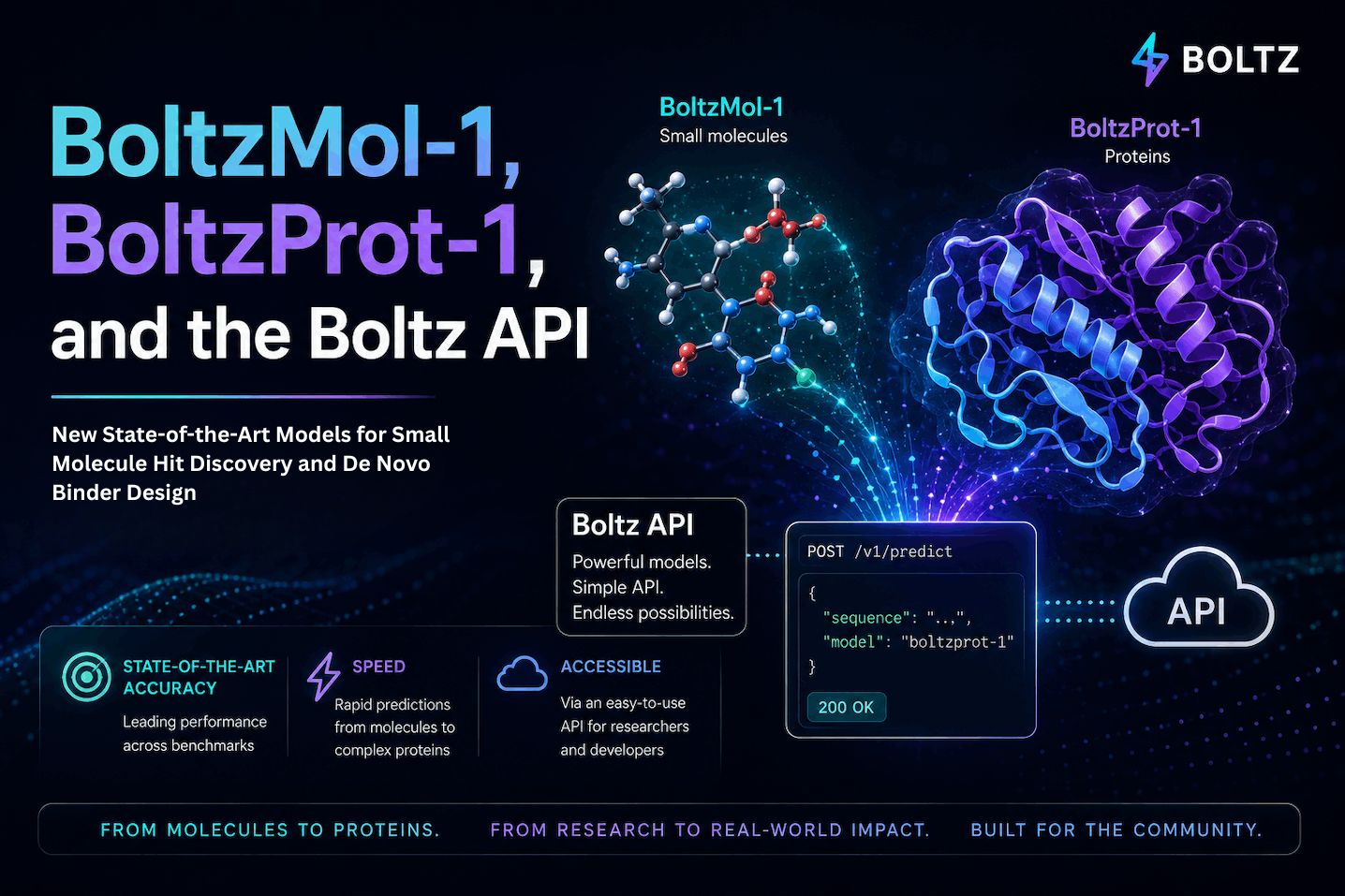
Drug discovery has always been brutally slow. You pick a target, screen hundreds of thousands of compounds, watch most of them fail, spend months on each experiment, and pray that something sticks. For most research teams, especially in academia, that process is simply out of reach. The cost alone can run into the tens of millions before you even have a confirmed hit. That might be changing faster than anyone expected. On June 16, 2026, the Boltz team released two new AI models, BoltzMol-1 and BoltzProt-1, for small-molecule hit discovery and protein design, along with a public API – signaling a major step toward AI-driven discovery that could cut therapeutic development timelines from months to weeks at a fraction of traditional costs.
The Problem They’re Solving
To understand why this matters, you need to appreciate how hideous the traditional hit-discovery process is.
Finding a small molecule that binds to a new drug target typically means running high-throughput screens (HTS), which involve physically testing tens of thousands to millions of compounds. Hit rates hover around 0.01 to 0.14 percent. You’re hunting for a needle in a haystack the size of a city. It costs hundreds of thousands of dollars, takes months, and even if your target is unusual or poorly characterized, it might not work.
The Boltz team asked a different question: what if an AI model could tell you, before you run the experiment, which 30–50 compounds are most likely to bind?
BoltzMol-1: Finding Drug Hits with 50 Compounds Instead of 50,000
BoltzMol-1 is their answer for small-molecule drug discovery. At its core is an optimized version of their earlier Boltz-2 model, which co-folds a protein-ligand complex and predicts binding affinity. Rather than just predicting structure, it generates a composite ranking score that tells you which compounds from a commercial catalog are most worth buying and testing.
The team validated this across ten challenging drug targets, proteins spanning kinases, GPCRs, transcription factors, ion channels, and autophagy proteins. Most of these targets had little to no representation in the model’s training data. These weren’t easy cases chosen to flatter the results.
The outcome: confirmed hits on 6 out of 10 targets, testing only 28 to 51 compounds per target.
For context, traditional HTS might test 100,000 compounds to find those same hits. BoltzMol-1 found them with 50.
A few highlights from the paper stand out. For MRGPRX2, a receptor involved in allergic reactions and pseudoallergic drug responses, they identified 10 agonists and 3 antagonists from just 38 compounds tested. For GLP-2R, a clinically validated gut receptor with almost no small-molecule structural data, they found 12 functional antagonists. For PknB, a kinase essential to Mycobacterium tuberculosis growth and an important target in the fight against drug-resistant TB, 16 out of 96 compounds showed confirmed activity.
The pipeline can screen buyable compounds from commercial catalogs or search an “ultra-large” make-on-demand chemical space of over 74 billion compounds using a generative active-learning workflow. It also includes built-in ADMET models, tools that predict how soluble, lipophilic, and permeable a compound is, filtering out molecules with poor drug-like properties before you ever run an assay.
The economics are striking. The team reports achieving target-to-validated hits in 3–8 weeks, with a total budget (compute + experimental) of $10,000–$15,000. Traditional HTS campaigns typically cost hundreds of thousands of dollars and run for months.
BoltzProt-1: Designing Protein Binders That Actually Work
On the biologics side, BoltzProt-1 tackles a different problem: designing protein binders, specifically nanobodies (also called VHHs, single-domain antibodies derived from camelids), from scratch.
The central innovation here is a new scoring model called BoltzPPI, a protein-protein interaction predictor built on top of Boltz-2. Most generative binder design pipelines focus on generating candidates and then ranking them by structural confidence scores. The problem is that structural confidence doesn’t correlate well with whether something actually binds in the lab. BoltzPPI is specifically trained to predict binding probability from the 3D interaction interface, giving a score that’s more directly tied to experimental success.
The results back this up. On a panel of 10 novel, low-homology targets, proteins with few close relatives in the training data, BoltzProt-1 achieved a 2.4-fold improvement in confirmed binder rate over BoltzGen, the team’s previous pipeline (8.0% vs. 3.3%). It was then tested against a published benchmark from Chai-2, another leading binder design model, and achieved screening hits for 7 out of 10 targets, compared with Chai-2’s 6 out of 10.
But what separates this from just a better hit-rate story is its developability. A nanobody that binds its target is useless as a drug if it aggregates, unfolds, sticks to everything nonspecifically, or can’t be manufactured at scale. The Boltz team ran their confirmed binders through a comprehensive panel: thermal stability, monomer purity, aggregation, hydrophobicity, nonspecific binding, and self-interaction.
58% of BoltzProt-1’s confirmed binders passed all developability criteria simultaneously. For comparison, clinical-stage nanobody controls, drugs that are already in or near human trials, passed at a rate of only 21%. That gap is meaningful. It suggests the model isn’t just finding binders; it’s finding binders with real therapeutic potential.
The API: Putting It in Everyone’s Hands
Both models are now accessible through the Boltz API, starting at $0.025 per prediction. Python and JavaScript SDKs are available, with integrations for Claude Code, Codex, and Gemini CLI, meaning these tools can be called directly from AI coding agents. The team has also partnered with platforms including Benchling, Amazon Bio Discovery, Rowan, and others to embed the API into tools scientists already use.
The data ownership terms are notable: you own the IP for everything you put in and get out, and Boltz does not retain your inputs to retrain models.
What This Actually Means
None of this removes the need for real experimental work. The 4 out of 10 targets where BoltzMol-1 didn’t find hits are a reminder that these tools have limits. Targets like mGlu4 PAM (requiring conformationally specific allosteric pharmacology) and Nav1.8 VSD2 (a clinically validated site with no small-molecule co-crystal structure) remain hard.
But the direction of travel is clear. For researchers working on early-stage hit discovery, especially those in academic labs or small biotechs without the budget for industrial-scale screening, tools like BoltzMol-1 and BoltzProt-1 represent a genuine shift in what’s achievable. The barrier to running a meaningful hit discovery campaign just got a lot lower.
If you want to try it, the API is live at api.boltz.bio. The team is also hosting launch events in Boston (June 18), San Francisco (June 22), and London (July 2).
Article Source: Reference Paper 1 | Reference Paper 2 | Reference Article | API
Disclaimer:
The research discussed in this article was conducted and published by the authors of the referenced paper. CBIRT has no involvement in the research itself. This article is intended solely to raise awareness about recent developments and does not claim authorship or endorsement of the research.
Follow Us!
Learn More:



Anchal is a consulting scientific writing intern at CBIRT with a passion for bioinformatics and its miracles. She is pursuing an MTech in Bioinformatics from Delhi Technological University, Delhi. Through engaging prose, she invites readers to explore the captivating world of bioinformatics, showcasing its groundbreaking contributions to understanding the mysteries of life. Besides science, she enjoys reading and painting.