
Antimicrobial resistance (AMR) has quietly become one of the defining health crises of our time, undermining the effectiveness of life-saving medicines and putting decades of medical progress at risk. Drug-resistant infections already claim more than 1 million lives each year and contribute to nearly 5 million deaths globally, with projections pointing to a staggering 39 million deaths by 2050 — equivalent to roughly three lives lost every minute. Now, a new study led by Professor Tania Dottorini at King’s College London sheds light on what’s driving this trajectory, examining how resistance genes across 16 WHO-prioritized pathogens interact with socioeconomic factors like poverty, sanitation, and healthcare access to shape the global AMR landscape through mid-century.
The researchers analyzed over 45k bacterial genomes using bioinformatics, considering 1000+ social and economic factors, and found that 210 pathogen-specific traits are projected to increase by 2050, with 32 high-risk threats directly linked to poor living conditions.
Microbes like bacteria, viruses, and fungi go through genetic changes or mutations over time, which sometimes lead them to evolve to survive the drugs designed to kill them and pose a threat to modern medicine for humans as well as plants and animals, along with an impact on agriculture and economics. Infections that were once easily treatable, like pneumonia, Tuberculosis, and UTI, can now be life-threatening if bacteria evolve resistance.
Root Causes of AMR: Are We Accelerating the Problem?
AMR is a natural process, but it is sped up by today’s internet-influenced health-conscious actions, such as the overuse of ‘over-the-counter’ or easily available antibiotics, antifungals, antivirals, etc, without proper prescriptions.
This overuse can lead to simple mutations or gene transfer in microorganisms, helping them develop resistance mechanisms, such as preventing the drug from entering or altering drug targets. An example could be misinformation spread online during COVID-19, which drove massive misuse of ivermectin, an antiparasite, without any evidence, which contributed to resistance in parasites.
AMR is responsible for millions of deaths each year, with 1.27 million deaths alone in the year 2019, just due to bacterial AMR. Controlling AMR can be easy with simple strategies such as responsible antimicrobial use, proper hygiene, vaccination, and research and development to stay ahead of resistant pathogens.
But previous studies focused on either biological or public health indicators at a time, not both. This was the ambitious goal behind the research to integrate diverse genomics datasets, introducing a structure-aware machine learning framework and socioeconomic data from around the globe to understand the complexity of resistance patterns in response to proactive actions.
Dataset and Pipeline of the Researcher’s Novel ML Model
The researchers hypothesize that combining genomic and phenotypic data along with social determinants of health, through advanced ML, can reveal patterns that have been driving AMR, even if hidden, to forecast AMR rising on a global level.
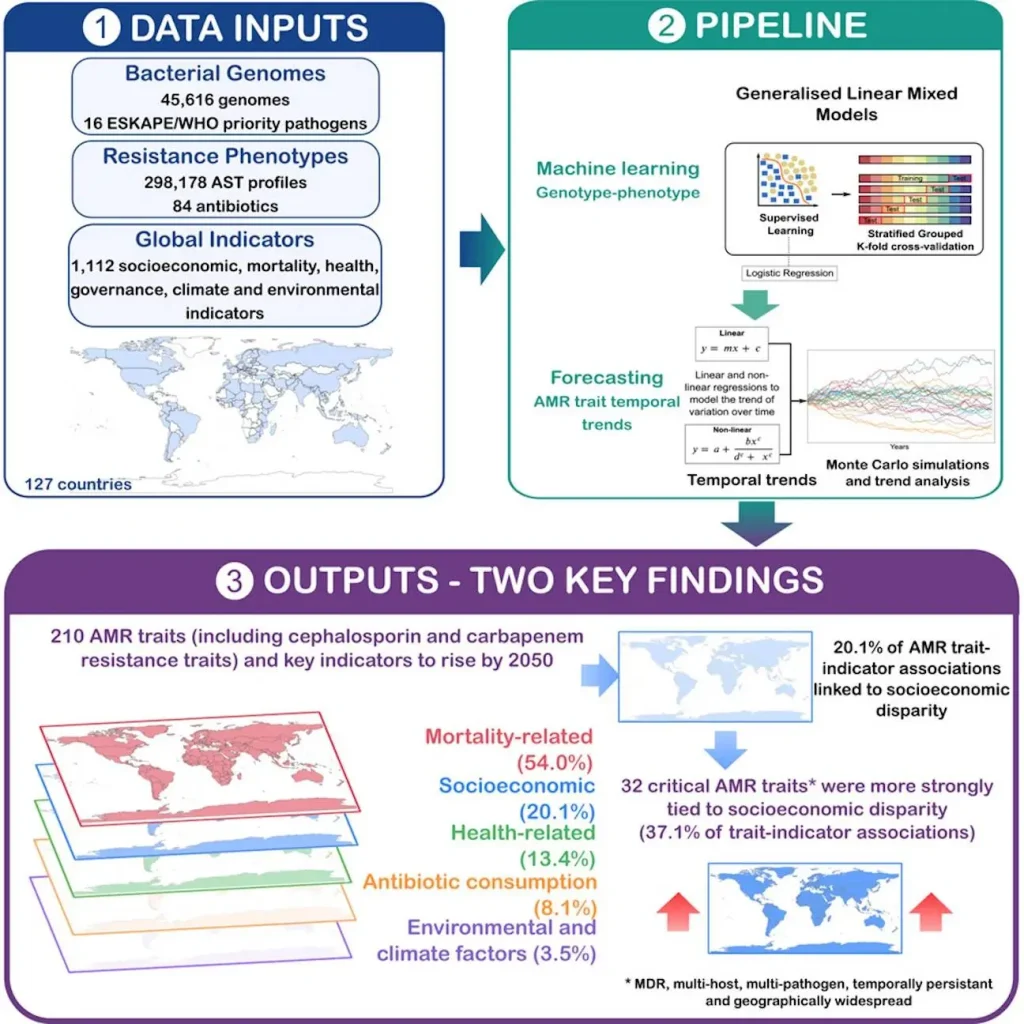
The team used predictive modeling to develop a novel ML pipeline that integrated ~45 thousand genomes from 16 species, including the six ESKAPE pathogens and nine WHO high priority ones such as E.coli, K.pnemoniae, A. baumannii, S. aureus, and M. tuberculosis from the Whole Genome Sequencing (WGS). This is to identify antibiotic resistance genes (ARGs) and mobile genetic elements (MGEs) that carry them.
About 298k antibiotic susceptibility testing (AST) profiles were considered to link genetics with real-world resistance phenotypes, along with contextual indicators like social and economic, environmental, and health-related variables from 127 countries covering antibiotic consumption, mortality, etc. This massive dataset forms the backbone of their machine learning model.
Methodology and Key Findings
After the identification of ARGs and MGEs, researchers calculated the proportion of resistant versus susceptible AMR traits from the isolates. They then connected these prevalence values to 1112 socioeconomic indicators across seven World Bank regions to compare bacterial genomes from different income groups.
They applied linear and non-linear regression models and Monte Carlo simulations to estimate the uncertainty and predict how each trait’s prevalence might change by 2050. The results were filtered so that only the traits projected to increase were flagged for deeper analysis, considering indicators to also be increasing or remaining stable.
At the very last step of analysis, researchers ranked the highest risk AMR traits using several criteria, including how strongly each trait is linked to treatment failure, their presence in ESKAPE pathogens, whether the traits can be spread between species worldwide, etc.
The key finding of the research was concerning part as researchers managed to find 210 AMR traits showing strong correlations and projected a global increase by 2050. Out of these, 32 traits were flagged as critical threats, not just because of their sharp rise but also their strong link to socioeconomic disparities, especially inequality and increasing carelessness in antibiotic consumption.
Limitations to be Addressed with Future Research
The study’s power lies in its scale, but the authors acknowledge that there are several structural imbalances that could affect the precision of their forecasts. These include:
- Uneven Representations: Certain hosts, years, and regions, for example, the UK, were overrepresented while low and middle-income countries were underrepresented. Sub-Saharan Africa carries the largest global AMR burden, yet contributes very few genomic sequences.
- Infrastructure Bias: The number of available genome data reflects the sequencing capacity. High-income countries have more data but lower infection rates, while low to middle-income countries face the opposite.
Even with these limitations, the authors stress that mapping genomic features to global indicators still yields actionable insights. It managed to prove itself both groundbreaking and self-aware.
Article Source: Reference Paper | | Reference Article | GitHub
Disclaimer:
The research discussed in this article was conducted and published by the authors of the referenced paper. CBIRT has no involvement in the research itself. This article is intended solely to raise awareness about recent developments and does not claim authorship or endorsement of the research.
Follow Us!
Learn More:



Saniya is a graduating Chemistry student at Amity University Mumbai with a strong interest in computational chemistry, cheminformatics, and AI/ML applications in healthcare. She aspires to pursue a career as a researcher, computational chemist, or AI/ML engineer. Through her writing, she aims to make complex scientific concepts accessible to a broad audience and support informed decision-making in healthcare.