
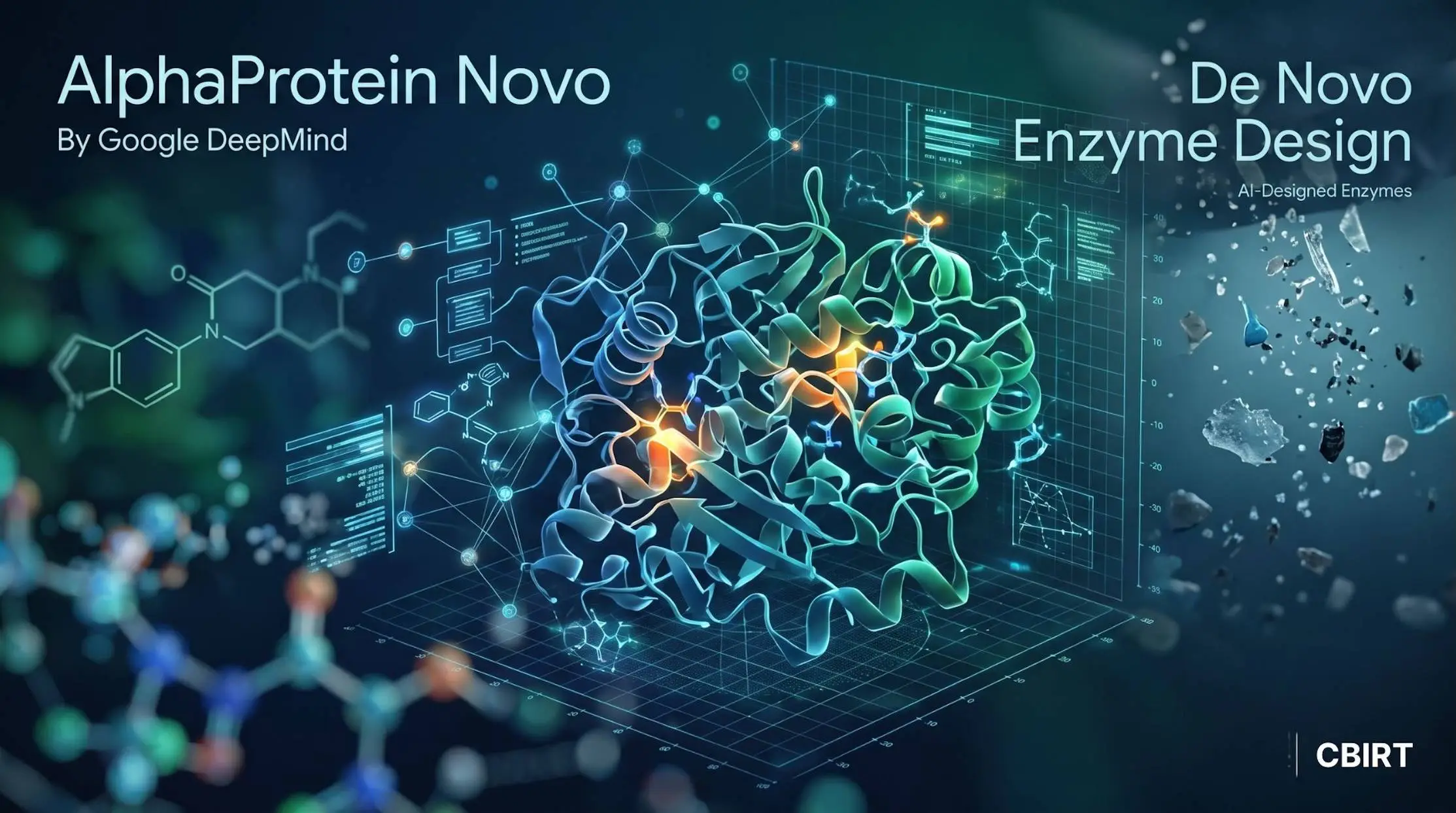
A team of researchers from Google DeepMind (London and Mountain View), the California Institute of Technology (Pasadena), and the University of Pittsburgh has just shared a bioRxiv preprint that could change how we find enzymes. They introduced AlphaProtein Novo (AP Novo), a machine-learning pipeline for designing enzymes from scratch.
First, why enzymes matter
Enzymes are the tiny molecular machines that speed up chemical reactions in living things. Industry uses them to make medicines, clean up waste, and reduce harsh chemicals. The usual way to get a useful enzyme is to hunt through nature for one that does something close to what you want, then tweak it in the lab. That works, but finding a good starting point can be slow, and sometimes nothing in nature does the job.
The other path is de novo design: building an enzyme from scratch. It has long been a dream, but designed enzymes have mostly been weak. The field has been moving quickly this year — other groups are now designing proteins from plain-English descriptions.
Meet AlphaProtein Novo
The tool is called AlphaProtein Novo, or AP Novo.
Here’s the basic recipe:
- Describe the key chemical groups an enzyme needs to do its job (the “catalytic motif”).
- Use a diffusion model, the same kind of AI behind many image generators, to build a protein around that motif.
- LigandMPNN, a separate sequence-design tool, produces the final amino acid sequence.
- Check each candidate with AlphaFold 3 predictions and throw out the ones that don’t look right.
- Test the survivors in the lab.
Win #1: Making piperidines
Piperidines are ring-shaped molecules found in lots of FDA-approved drugs. The team wanted an enzyme that could make them through a reaction not seen in nature. The trouble is that the starting chemical can close into either a five-membered ring (pyrrolidine) or a six-membered ring (piperidine), and natural enzymes strongly prefer the five-membered one. The researchers screened 188 natural and engineered proteins. Nine showed real activity, and none exceeded a 30:70 piperidine-to-pyrrolidine ratio — i.e., pyrrolidine still dominated.
The designed enzymes did far better. Their best one, GDM_NT_270, made piperidine at a 99:1 ratio over the alternative, with 94% enantiomeric excess (meaning it picked one “handedness” of the molecule). It managed 22 turnovers, roughly a hundred times better than the natural starting protein for this product.
Win #2: Breaking down a plastic additive
DEHP is a plasticizer found everywhere in the environment, and it’s linked to hormone disruption. Natural enzymes struggle with it because the molecule is bulky and barely dissolves in water. One earlier study tested 65 natural esterases and found just one that worked.
The AP Novo team designed enzymes using the same serine-based chemistry many natural enzymes use. After three rounds, about 11% of their fully new designs and 39% of their reworked designs were active. That beats natural screening.
At room temperature, the best design was less active than natural DEHP-degrading enzymes. But it has a surprising strength. The design called GDM_DEHP_376 worked 14 times better at 90 °C than at room temperature, and it still worked in 75% acetonitrile, a solvent that wipes out most proteins. The two natural enzymes they compared against were completely inactive in those conditions. It’s also small, only 191 amino acids.
Setting new records on test reactions
The team also tried classic benchmark reactions. Their best design at pH 7.5, GDM_KE_1483, reached 14,600 M⁻¹s⁻¹; a separate design reached about 45,000 M⁻¹s⁻¹ at pH 10. They report the first number is about 70 times higher than earlier fully new designs. Their best serine esterase hit 360,000 M⁻¹s⁻¹, though that one resembles natural enzymes in shape. The best design with a truly unnatural shape reached 4,900, still around four times better than previous efforts.
The real insight: judge the backbone, not just the sequence
Instead of scoring a designed protein on one sequence, the team generated many different sequences for the same backbone and checked whether they all passed the filters. If a backbone only works with one lucky sequence, it’s probably fragile. If it works with many, it’s probably solid.
This “multi-resequence” scoring made a big difference. Hit rates for Kemp enzymes roughly doubled, and for serine esterases they rose as much as 30-fold. Combining it with a second approach, partial diffusion, gave retrospective hit rates of 60% and 80% on the two reactions. The authors think this may explain why other iterative design pipelines have worked so well.
The limits
The authors are upfront about the downsides:
- Designed enzymes are still orders of magnitude slower than natural ones or lab-evolved ones.
- Setting up a new reaction takes real chemical expertise.
- You often need to generate huge numbers of candidates to find a few good ones.
- The models don’t truly capture the physics of catalysis.
Why it matters
This isn’t a finished product. The DEHP enzymes, for example, can’t yet fully break the chemical down. But as starting points for further engineering, they look promising, especially since they tolerate heat and solvents that kill natural enzymes. The bigger message is that AI-designed enzymes are moving from curiosity to a practical tool. The code and model weights are free for non-commercial use on GitHub, so other labs can build on it. Keep an eye out for follow-up work. Open release raises a tracking question the same lab has been working on separately — watermarking AI-designed proteins so they can be identified later.
Frequently Asked Questions
AlphaProtein Novo (AP Novo) is a machine-learning pipeline developed by Google DeepMind for de novo enzyme design. Unlike traditional protein engineering methods that modify existing natural enzymes, AP Novo co-generates 3D protein structures and amino acid sequences from scratch around a catalytic site to target specific chemical reactions.
AlphaProtein Novo uses a multi-step generative design process:
Motif Scaffolding: Generative models generate new protein structures and sequences wrapped around a target catalytic motif.
AlphaFold 3 Mechanism Filters: Designs are evaluated using AlphaFold 3 predictions to verify precise 3D geometry and active-site alignments required for catalysis.
Sequence-Ensemble Scoring: Multiple sequence variants are generated from the same backbone and scored in silico; backbones whose variants all pass the filters are prioritized.
AP Novo can outperform natural sequence mining in specific complex reactions where nature lacks efficient enzymes. While natural enzymes often struggle with harsh conditions or unnatural substrates, AP Novo-designed enzymes demonstrate unprecedented product selectivity and survive extreme environments like high temperatures and chemical denaturants.
Pharmaceutical Synthesis: Designed new-to-nature nitrene transferases that synthesize the pharmacophore piperidine with high product selectivity.
Environmental Bioremediation: Engineered enzymes to degrade di(2-ethylhexyl)phthalate (DEHP)—a toxic plasticizer—under denaturing conditions.
Industrial Chemistry: Achieved state-of-the-art catalytic efficiencies on classic model reactions, including the Kemp elimination and serine ester hydrolysis.
Traditional protein engineering is limited by natural evolutionary starting points, which are often hard to discover or unsuitable for industrial conditions. De novo design creates custom biological catalysts tailored for arbitrary chemical reactions from first principles, unlocking sustainable methods for drug development, plastic recycling, and green chemistry.
Reference: Wu, Z., Abramson, J., et al. (2026). Designing enzymes for new-to-nature chemistry and non-natural substrates with AlphaProtein Novo. bioRxiv. https://doi.org/10.64898/2026.10.01.756017 Posted October 5, 2026
AlphaProtein Novo GitHub repository: https://github.com/google-deepmind/alphaprotein-novo
Disclaimer:
The research discussed in this article was conducted and published by the authors of the referenced paper. CBIRT has no involvement in the research itself. This article is intended solely to raise awareness about recent developments and does not claim authorship or endorsement of the research.
Important Note: bioRxiv releases preprints that have not yet undergone peer review. As a result, it is important to note that these papers should not be considered conclusive evidence, nor should they be used to direct clinical practice or influence health-related behavior. It is also important to understand that the information presented in these papers is not yet considered established or confirmed.
Follow Us!

Anchal is a consulting scientific writing intern at CBIRT with a passion for bioinformatics and its miracles. She is pursuing an MTech in Bioinformatics from Delhi Technological University, Delhi. Through engaging prose, she invites readers to explore the captivating world of bioinformatics, showcasing its groundbreaking contributions to understanding the mysteries of life. Besides science, she enjoys reading and painting.





, an AI pipeline using AlphaFold 3 to design custom de novo enzymes from scratch for pharma and plastic waste.)