Bioinformatics Course in India (2026): Types, Fees, Eligibility and How to Choose
By Dr. Tamanna Anwar, PhD, Founder, Centre of Bioinformatics Research and Technology (CBIRT)
Search for “bioinformatics course” and you get a confusing mix: four-year degrees, free university videos, PG diplomas and paid certificates, all claiming to make you job-ready. They are not interchangeable. Each one suits a different starting point, budget and goal.
This guide compares every type of bioinformatics course available to students in India, with real fee ranges, eligibility rules and the skills each one should teach. It ends with a 10-point checklist you can use before you pay anyone, including us.
Quick answer: which bioinformatics course should you take?
| If you are… | Best fit | Typical time |
|---|---|---|
| A 12th-pass science student | BSc or BTech in bioinformatics | 3–4 years |
| A BSc graduate in any life science | MSc in bioinformatics, or a PG diploma | 1–2 years |
| A student or researcher who needs one skill now (NGS, Python, docking) | A live, hands-on short course | 1–4 weeks |
| Curious and on a zero budget | A free NPTEL or university course | 12 weeks, self-paced |
| A working professional moving into bioinformatics | PG diploma or a series of short courses with projects | 6–12 months |
The right choice depends less on the course name and more on three things: what you already know, the specific skill you need, and whether you will work with real data during the course.
Types of bioinformatics courses in India, compared
The routes fall into three groups: degrees, diplomas and short courses. Fees vary enormously: a government MSc can cost less than a single private certificate. The ranges below are average annual fees reported by Collegedunia (updated April 2026), so check the exact fee with each institute.
| Course type | Duration | Eligibility | Average annual fee (₹) | Best for |
|---|---|---|---|---|
| BSc Bioinformatics | 3 years | 10+2 with PCB/PCBM, usually 50–55% | 2,850 – 2,45,000 | 12th-pass students who want a degree |
| BTech / BE Bioinformatics | 4 years | 10+2 with PCBM, 50–55%, entrance exam if applicable | 39,500 – 2,50,000 | Students strong in maths and programming |
| MSc Bioinformatics | 2 years | Bachelor’s in a relevant subject, 50–55%, entrance exam if applicable | 6,720 – 1,64,000 | Life-science graduates aiming for research or industry |
| MTech / ME Bioinformatics | 2 years | Relevant bachelor’s degree, 50–55% | 11,000 – 3,10,000 | Engineering graduates |
| PG Diploma | Usually 1 year | Graduation in science (BSc with PCB as one subject, or equivalent) | 6,000 – 65,000 | Graduates who want a faster, focused route |
| Diploma / Advanced Diploma | Months to 1 year | 10+2 science for diplomas | 3,900 – 1,00,000 | Learners testing the field before a degree |
| Certificate and short courses | 1 week to a few months | Usually none; basic biology helps | 5,000 – 2,45,469 for listed certificates | Students and professionals who need one skill quickly |
Two things stand out. First, the gap between the cheapest and most expensive option in every row is huge, so price alone tells you nothing about quality. Second, degrees give you a qualification, while short courses give you a specific skill. Many successful bioinformaticians combine both: a degree for eligibility, plus focused hands-on training for the tools employers actually ask for.
Degree routes and entrance exams
After 12th: BSc or BTech
Most colleges ask for 10+2 with Physics, Chemistry and Biology (or Mathematics) and 50–55% marks. Admission is through merit lists or entrance exams; Collegedunia lists TANCET, OJEE, IPU CET and JEE Main among the exams used, depending on the institute.
Is NEET required for bioinformatics?
No. According to the National Testing Agency, NEET (UG) is the entrance exam for undergraduate medical education and for BAMS, BUMS, BSMS and BHMS. Bioinformatics is not on that list, so you do not need a NEET score for a BSc, BTech or MSc in bioinformatics.
After graduation: MSc or MTech
Central universities typically admit MSc students through CUET PG. One example: the MSc in Computational Biology and Bioinformatics at the Central University of Himachal Pradesh is a two-year, full-time program that admits through CUET PG, accepts a bachelor’s in any science stream with at least 50% marks, and lists a total fee of about ₹24,100 for 33 seats (Careers360).
PhD
A PhD needs a relevant master’s degree and a national or university entrance exam such as UGC NET or IIT JAM, as listed by Collegedunia. A PhD is the usual route to research scientist and faculty roles.
Tip: a degree makes you eligible; it does not guarantee you can run an analysis. Before you finish your degree, make sure you have handled real sequencing or structural data yourself, whether in a project, an internship or a hands-on course.
Free and low-cost online bioinformatics courses
If you want to test your interest before spending money, start with a free course. Two strong options:
| Course | Provider | Length | Cost | Certificate |
|---|---|---|---|---|
| BioInformatics: Algorithms and Applications | IIT Madras on NPTEL/SWAYAM (Prof. Michael Gromiha) | 12 weeks | Free to learn | Optional proctored exam, ₹1,000 fee |
| Bioinformatics Specialization | UC San Diego on Coursera | 7 courses, about 3 months at 10 hours a week | Paid enrollment; financial aid available | Shareable certificate |
The NPTEL course covers sequence analysis, databases, alignment and BLAST, phylogenetics, protein structure, and an introduction to computer-aided drug design. It is an excellent theory foundation.
Where free courses fall short: they are mostly recorded lectures. You rarely run a full pipeline on your own machine, get stuck, and have an expert fix your error in real time. That practical troubleshooting is the skill a job actually demands. Use free courses for concepts, then add hands-on practice with real datasets.
What a good bioinformatics course should teach
Whatever the format, compare the syllabus against this list. A course that names its tools is far easier to judge than one that promises “industry-relevant skills”.
| Skill area | Tools you should actually use | Why it matters |
|---|---|---|
| Command line | Linux shell, file handling, running tools on a server | Almost every genomics tool runs from the terminal |
| Programming | Python with Biopython; R with Bioconductor | Automating analysis and making plots for papers |
| Biological databases | NCBI (GenBank, SRA), UniProt, PDB, Ensembl | Finding and downloading real data |
| Sequence analysis | BLAST, multiple sequence alignment, phylogenetic trees | The foundation of most bioinformatics work |
| NGS data analysis | FastQC, read alignment (BWA, HISAT2), SAMtools, variant calling (GATK) | Genomics and clinical labs run these pipelines daily |
| Structural bioinformatics and drug discovery | PyMOL, molecular docking (AutoDock Vina), QSAR | Pharma and drug-discovery roles |
| Reproducible workflows | Galaxy, Git, workflow managers such as Snakemake or Nextflow | Sharing analysis others can rerun |
You do not need all of this from one course. A beginner course should cover the first four rows; a specialized course (NGS, drug discovery) should go deep on one row and leave you with a finished project.
For a reference list, see our guides to bioinformatics databases and tools and the top 30 Python libraries used in bioinformatics. Not sure which language to learn first? Read R vs Python for bioinformatics. To see what an NGS pipeline looks like in practice, try our NGS data analysis for beginners walkthrough.
How to choose a bioinformatics course: a 10-point checklist
Ask these questions before you pay for any course, including ours.
- Does the syllabus name specific tools? “BLAST, BWA, GATK” is a promise you can check; “industry tools” is not.
- Will you analyze real data yourself? Look for named public datasets (for example from NCBI SRA or TCGA), not only slides.
- Is it live or recorded? Live sessions let you ask questions when an error stops you. Recorded courses suit self-motivated learners.
- Who teaches it? Trainers should be named, with their qualifications and research or industry experience visible.
- What do you finish with? A project, a pipeline or a report you can show an interviewer is worth more than a certificate alone.
- Does it match your level? Beginners need Linux and basics first; jumping straight into NGS pipelines rarely works.
- How is the time scheduled? Evening batches suit students and working professionals; check the timezone if you are outside India.
- What exactly does the fee include? Recordings, materials, software access, certificate, doubt-clearing after sessions.
- Can you see the full curriculum before paying? A session-by-session plan is a sign of a well-prepared course.
- What do past learners say? Read reviews on Google or LinkedIn rather than testimonials only on the course page.
Red flags
- “100% placement guaranteed” with no published placement data
- No trainer names, or trainers with no visible background
- A syllabus that is all theory, with no datasets or tools listed
- Pressure to pay immediately with “last seat” countdowns that never end
- Internships that charge a fee but offer no real project or mentor
What can you do after a bioinformatics course?
Common entry roles include bioinformatics analyst, research associate or project fellow in a research lab, NGS data analyst, and computational biologist. Indeed India lists a national average salary of ₹4,73,606 a year for a bioinformatics analyst; actual pay depends heavily on your degree, city, employer and, above all, the tools you can use confidently.
Bioinformatics job descriptions usually ask for named skills (Linux, Python or R, NGS pipelines, specific databases) and evidence you have used them. That is why a project portfolio matters as much as the course you took. For roles, pay and how to apply, see our guide to bioinformatics jobs for freshers.
Learn bioinformatics live with CBIRT
CBIRT (Centre of Bioinformatics Research and Technology) is an ISO 9001:2015 certified, MSME-registered training and research organization. We run live, online, hands-on courses taught by experienced trainers, and have trained more than 2,000 learners from over 20 countries.
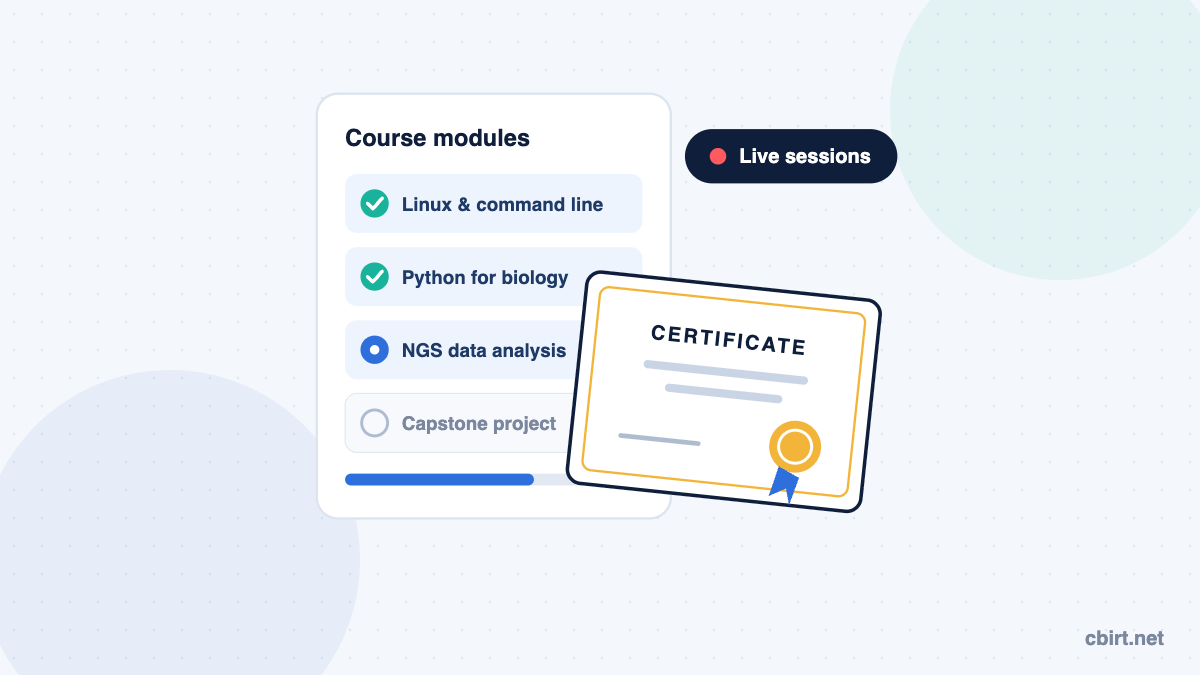
Our programs are industry-focused skill development courses. Each one names its tools, works on public datasets, runs as live sessions where you can ask questions as you go, and ends with an assignment or project. Every learner who completes a program receives a certificate.
| Course | Who it is for | Next batch |
|---|---|---|
| Introduction to Bioinformatics | Complete beginners | See current dates |
| Python & Biopython for Bioinformatics | Beginners who want to code | See current dates |
| R for Bioinformatics | Students who need statistics and plots | 3–17 Nov 2026 |
| NGS Data Analysis | Learners ready for real sequencing data | 3–17 Nov 2026 |
| Python & Biopython + R internship package (1 month) | Students who want a structured project | See current dates |
Fees start at ₹1,199 for Indian students and USD 25 for international students for a one-week program, and vary by category and duration. See all current courses and fees →
For questions, write to info@cbirt.net or WhatsApp +91 6398142849.
Frequently asked questions
What is a bioinformatics course?
A bioinformatics course teaches you to store, analyze and interpret biological data, such as DNA, RNA and protein sequences, using computers. It ranges from a four-year degree to a one-week hands-on program on a single skill.
How do I join bioinformatics after 12th?
With 10+2 in science (PCB or PCBM, usually 50–55%), you can apply for a BSc or BTech in bioinformatics through merit lists or entrance exams. You can also start a free online course to explore the field first.
Is NEET compulsory for bioinformatics?
No. NEET (UG) is used for undergraduate medical education and AYUSH degrees such as BAMS and BHMS. Bioinformatics degrees do not require it.
Can I learn bioinformatics online?
Yes. Free courses such as IIT Madras’s NPTEL course teach the theory, and live online courses add hands-on practice with real data and an instructor to help when you get stuck.
What is the fee for a bioinformatics course in India?
It ranges from free (NPTEL, with a ₹1,000 optional exam) to a few thousand rupees for a short course, and up to about ₹3 lakh a year for some private degree programs, according to Collegedunia’s averages.
Which is better: a degree or a short course?
They do different jobs. A degree makes you eligible for most roles; a short course gives you a specific, job-ready skill. Most learners benefit from both.
What jobs can I get after a bioinformatics course?
Bioinformatics analyst, research associate, NGS data analyst and computational biologist are common starting roles in research institutes, genomics companies, pharma and CROs.
Sources
- Collegedunia: Bioinformatics course fees and eligibility, updated April 2026
- National Testing Agency: NEET (UG)
- Careers360: MSc Computational Biology and Bioinformatics, CU Himachal Pradesh
- Careers360: BioInformatics: Algorithms and Applications (IIT Madras, NPTEL)
- Coursera: Bioinformatics Specialization, UC San Diego
- Indeed India: Bioinformatics jobs in India, updated June 2026
Related reading on CBIRT: What is bioinformatics? · Bioinformatics databases and tools · Bioinformatics internship in India · NGS data analysis for beginners · R vs Python for bioinformatics · Bioinformatics jobs for freshers · Bioinformatics projects for your portfolio