GPN-Star: A Compact DNA Language Model That Reads Evolution to Predict Which Variants Matter
Researchers at the University of California, Berkeley, with collaborators at The Jackson Laboratory and the German Cancer Research Center (DKFZ), have introduced GPN-Star, a genomic language model that learns which parts of the genome are functionally constrained by studying how DNA has changed across species. The study, co-led by Chengzhong Ye and Gonzalo Benegas with Yun S. Song as corresponding author, appeared online in Nature in September 2026 and in the journal’s 5 November print issue. The paper is open access.
GPN-Star succeeds GPN-MSA, the alignment-based model CBIRT covered in 2023. The new model adds an explicit sense of evolutionary relationships.
What makes GPN-Star different
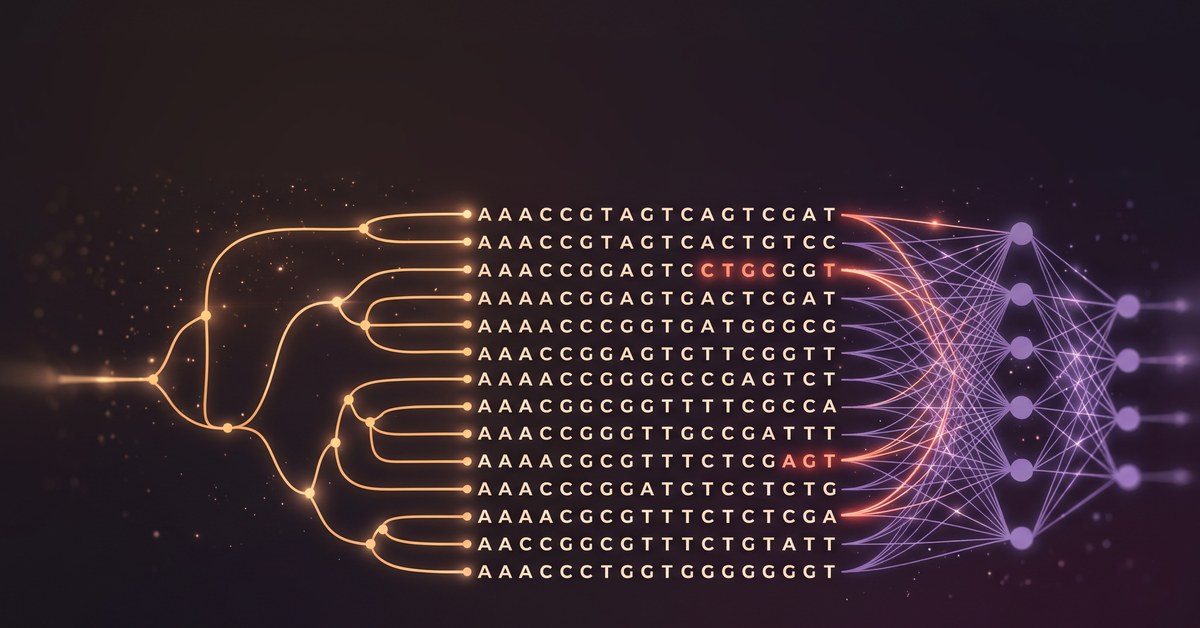
Most DNA language models learn from raw sequence. GPN-Star instead takes as input a whole-genome alignment, meaning the same stretch of DNA lined up across many species, together with the species tree that relates them. Positions that stay unchanged over millions of years of evolution are likely to be important, so a variant there is more likely to be harmful.
Under the hood, GPN-Star is an encoder-only transformer trained to fill in masked bases. Two design choices make it “phylogeny-aware”:
- Sequences from related species are pooled into clade-level summaries that follow the branches of the species tree.
- A cross-attention step weights each species by its evolutionary distance from the target genome.
The model’s raw predictions mix the effects of mutation rate and natural selection. The authors therefore calibrate scores against a background estimated from neutral sites, so the final score better reflects selection.
Three timescales, three models
The team trained separate human models on alignments of vertebrates, mammals and primates, named GPN-Star (V), (M) and (P). Which one worked best depended on the task:
- Coding variants: the vertebrate model gave the best ClinVar missense results among genome-wide models and clearly led on cancer-associated COSMIC variants. Protein-specific tools such as AlphaMissense and PrimateAI-3D still scored highest on ClinVar and ProteinGym. However, adjusting GPN-Star (V) for population allele frequency lifted it above PrimateAI-3D and close to AlphaMissense.
- Non-coding variants: the mammal model performed best at separating pathogenic variants from common ones, beating sequence-to-function models including Enformer, Borzoi and AlphaGenome, with the largest margin in distal enhancers. It also led on fine-mapped GWAS variants across 65 coding and 83 non-coding UK Biobank traits.
- Complex traits: the primate model showed the strongest heritability enrichment across 106 traits, and was most informative for highly polygenic traits.
Real gains in gene discovery
The authors added GPN-Star scores to DeepRVAT, a rare-variant association method, using exome data from 161,822 UK Biobank participants across 34 traits. The number of significant genes rose from 383 to 402, and the number replicated in larger independent studies rose from 338 to 353.
Small model, big results
The largest GPN-Star models have about 200 million parameters and trained in several days on 8 NVIDIA A100 GPUs. By comparison, the authors note that Evo 2 required more than 2,000 H100 GPUs for months. The team also trained versions for mouse, chicken, fruit fly, C. elegans and Arabidopsis.
Takeaways for researchers
- Variant prioritisation: GPN-Star offers genome-wide scores that work for coding and non-coding variants, including regulatory regions where many tools struggle.
- Pick the timescale: deeper alignments suit protein-coding and rare-disease variants, and primate alignments suit polygenic traits.
- Accessible compute: strong performance does not require a frontier-scale model.
- Open code: the model source code is archived on Zenodo (DOI 10.5281/zenodo.21501177).
Would you add an evolution-aware score like GPN-Star to your variant-annotation pipeline? Share how you prioritise non-coding variants today.
Reference: Ye, C., Benegas, G., Albors, C., Li, J. C., Prillo, S., Fields, P. D., Clarke, B. & Song, Y. S. Predicting genome-wide functional constraints with GPN-Star. Nature 659, 141 (2026). https://doi.org/10.1038/s41586-026-11005-5
Disclaimer:
The research discussed in this article was conducted and published by the authors of the referenced paper. CBIRT has no involvement in the research itself. This article is intended solely to raise awareness about recent developments and does not claim authorship or endorsement of the research.