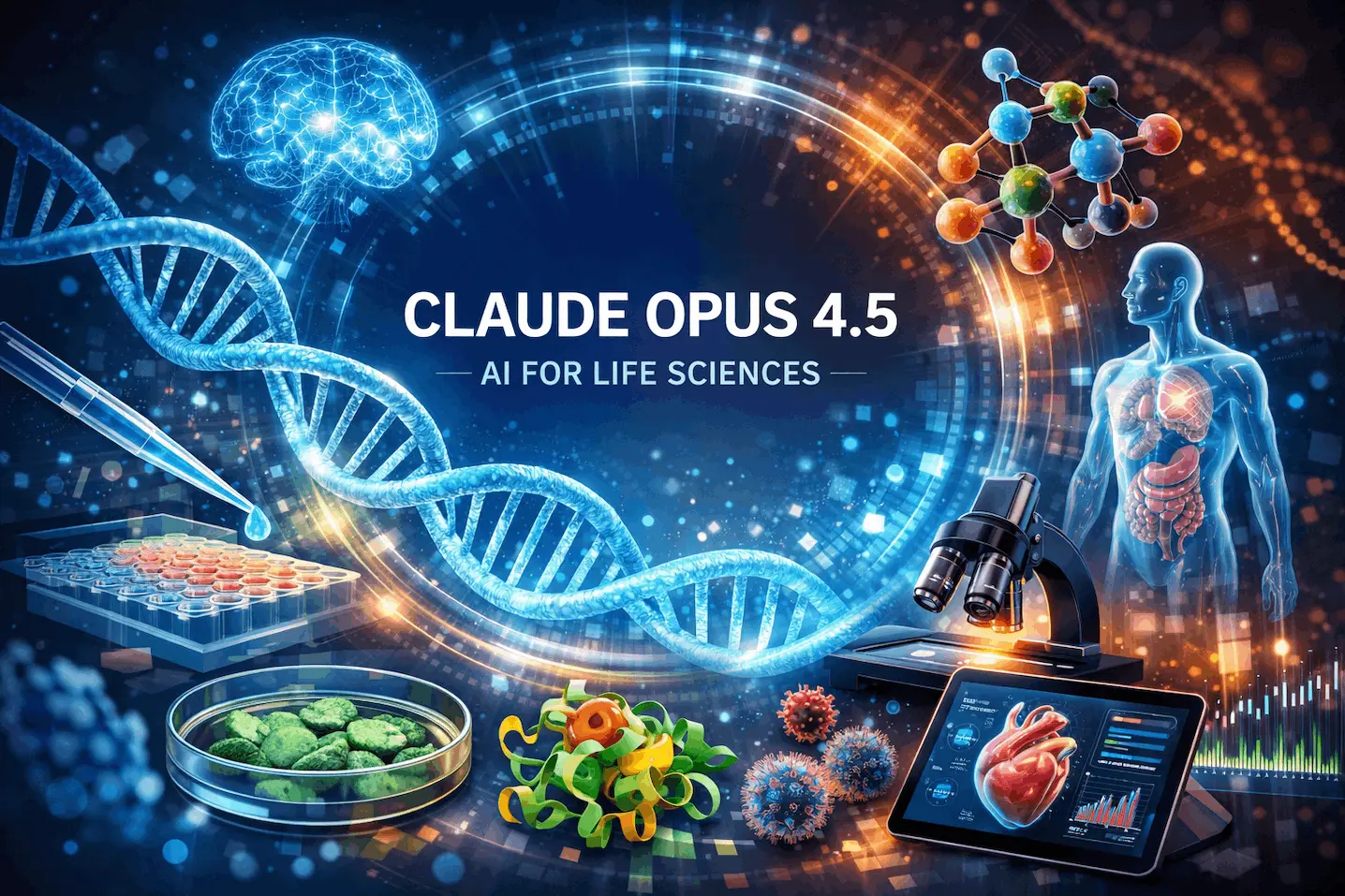
The growing complexity of biomedical research and healthcare demands AI systems that can go beyond general assistance to support end-to-end scientific workflows. Building on this need, Anthropic has expanded its Claude for Life Sciences initiative with the launch of Claude Opus 4.5, alongside new scientific and healthcare connectors and specialized agent capabilities. Designed with privacy-first, HIPAA-ready data handling, the platform aims to support the full continuum—from bioinformatics analysis and preclinical research to clinical trials, regulatory operations, and patient-facing applications—positioning AI as a practical partner across the modern life sciences and healthcare pipeline.
What is Claude Opus 4.5?
Claude Opus 4.5 is a hybrid reasoning AI model that allows users to control the depth of its reasoning before responding. It has a normal mode for fast reply and an extended thinking mode for complex reasoning. A new “effort” setting allows users to balance speed, cost, and accuracy by adjusting how much reasoning the model uses. The model was trained on a mix of publicly available data (up to May 2025), licensed third-party data, opt-in user data, and internally generated data, while maintaining safety and data-use standards.
Benchmarking and Validation
Claude Opus 4.5 was evaluated across a wide range of coding, agentic, and safety benchmarks, showing strong real-world performance. On the SWE-bench, it was tested on 3 versions: verified benchmark, pro, and multilingual. It solved 80% of problems on the verified benchmark, 52% on the much harder pro benchmark, and 76-81% on the multilingual version, demonstrating strong coding capability across multiple programming languages. With only a modest performance drop on Terminal-Bench, it solved 59% of the tasks with extended thinking and 50% with reduced thinking. In BrowseComp-Plus, it outperformed other Claude models and performed competitively with GPT-5.
It also handled retail and telecom customer service tasks more efficiently than earlier models, showing strong policy awareness; it scored 66.26% on OSWorld, indicating solid performance on multimodal computer tasks and showing strong ability in structured problem solving, coordinating, and combining work across multiple AI agents, making it effective for complex research and long-horizon planning. Across reasoning, tool use, math, science, and autonomous web tasks, it often surpassed previous models and achieved state-of-the-art results in single-agent settings.
It achieved a 99.8% harmless response rate on violence prompts across six languages, with <0.3% refusal on benign queries. It also demonstrated strong performance in ambiguous and multi-turn cases, high political neutrality, and near-zero social bias on the Bias Benchmark for QA (BBQ), and refused 100% of malicious coding requests, as well as followed the Gray Swan AI benchmark for prompt-injection resistance. It shows strong safety and alignment performance; it is warm, empathetic, and less sycophantic. In CBRN evaluations, it exceeded ASL-3 thresholds but remained below ASL-4, showing improved biology capabilities without enabling dangerous uplift. Autonomy tests confirm it does not automate full AI R&D roles.
Claude in Healthcare
Claude in healthcare has 3 connectors and 2 agents designed through the integration of CMS policies, clinical guidelines, and patient-specific records by adhering to HIPAA compliance requirements to support real-world clinical, administrative, and research workflows.
The three connectors include:
Centers for Medicare & Medicaid Services (CMS) coverage databases: this enables user verification of medical coverage and support authorization checks, improving revenue cycle management and regulatory compliance.
The International Classification of Diseases, 10th Revision (ICD-10), helps users by enhancing medical coding accuracy, billing reliability, and claims management.
The National Provider Identifier (NPI) registry helps with claims validation, network directory management, credentialing, and provider verification.
Agents: Prior authorization support offers templates that can be customized to meet the needs of users and researchers, including patient records, clinical guidelines, and supporting documentation. & FHIR Development: makes it possible for healthcare systems to exchange data in a safe and organized manner.
In the U.S. Cloud, Pro and Max users can connect the lab results and health records via the HealthEx function, Apple Health, and Android Health Connect, and it gives users a simplified view of their personal health data. Claude also enables healthcare startups to build AI-powered solutions on the cloud developer platform, including standardized clinical documentation tools, chart review systems, and clinical decision support applications.
Claude in Life Science
Claude Sonnet 4.5, an AI for life sciences, was launched in October 2025, with some additional advancements introduced in January 2026, representing a substantial evolution of Claude. Claude Sonnet 4.5 already had a defining capability for life sciences as it includes features that enable direct interaction with external scientific platforms and data sources through its connector cloud, providing access to PubMed for biomedical literature review, Benchling for experimental design and laboratory management, Synapse.org for collaborative analysis and secure project sharing, and Next Genomics for single-cell and spatial transcriptomics workflows. Researchers can easily switch between various platforms for data generation and analysis due to these integrations. For life science, Claude has integrated more tools to support multiple stages of the research pipeline, like
- Medidata: supports clinical trial planning and site performance monitoring.
- ClinicalTrials.gov: Supports trial discovery and participant recruitment.
- The Tool Universe: Provides access to over 600 scientific tools.
- BioRxiv and MedRxiv: Help users access the latest research and preprints.
- Open target: For drug target discovery
- ChEMBL: To provide data on bioactive and drug-like compounds
- Owkin AI: A driven pathology analysis for tissue imaging to support translation research.
A scientific problem selection agent, which converts instrument-generated data into an Allotrope-compliant format supporting bioinformatic workflow and clinical trial tasks like clinical trial protocols, supporting data management in clinical operations, preparing regulatory documentation workflow, and clinical trial protocol development.
Conclusion
Claude (model Opus & Sonnet 4.5) provides a platform that combines advanced reasoning, strong safety alignments, and real-world applicability across health care and life science with HIPAA-compliant features, access to health records, and support for clinical, administrative, and research workflows. It streamlines clinical operations and life science research. Unlike models limited to early drug discovery, Claude supports end-to-end R&D, bioinformatics pipelines, and clinical studies. While powerful, it operates within strict safety limits to prevent misuse as capabilities evolve.
Sources: Reference Article
Other Sources: https://youtu.be/sHImlfVM9r4
https://assets.anthropic.com/m/12f214efcc2f457a/original/Claude-Sonnet-4-5-System-Card.pdf
Disclaimer:
The research discussed in this article was conducted and published by the authors of the referenced paper. CBIRT has no involvement in the research itself. This article is intended solely to raise awareness about recent developments and does not claim authorship or endorsement of the research.
Follow Us!
Learn More:



Jainab Shaikh is a postgraduate in Biotechnology with a strong interest in understanding how research translates into real-world innovation. Her areas of focus include biosensors, bioinformatics, and sustainable biotechnological applications. She is passionate about exploring recent scientific advancements and communicating them through clear, engaging, and accessible content. Her work particularly emphasizes research-driven narratives in healthcare, biotechnology, skincare science, and emerging life science innovations.