tmol: Rosetta’s Energy Function, Rebuilt on the GPU for Machine Learning
Researchers at the University of Washington’s Institute for Protein Design (IPD), with collaborators at Prescient Design (Genentech), NVIDIA, the University of North Carolina at Chapel Hill, the Korea Institute of Science and Technology and the Wistar Institute, have released tmol, a GPU-native rebuild of the Rosetta energy function made to work inside machine learning pipelines. The work was posted as a preprint on arXiv on 16 November 2026 and has not yet been peer-reviewed.
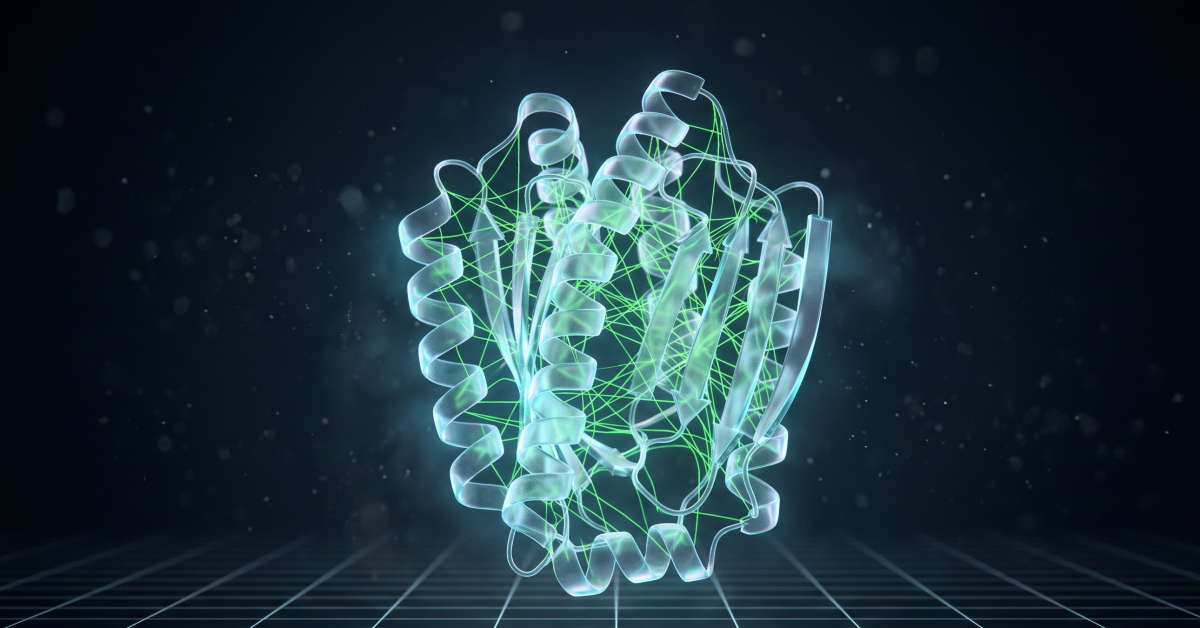
Rosetta has been a workhorse of protein modelling for over two decades, but it runs on CPUs and was never built to plug into deep learning code. tmol reimplements its current all-atom force field, RosettaGenFF, as batched PyTorch tensor operations: a physics-based score fast enough to sit inside an AI design loop, returning gradients a model can learn from.
Why AI protein models still need physics
Generative models such as AlphaFold 3 and RFdiffusion have transformed structure prediction and design. The authors note, however, that these models generalise poorly to chemistry that is thin in their training data: docking accuracy drops for unfamiliar pockets and ligands, and RNA structure prediction degrades sharply on novel folds. Generated structures can look plausible while breaking basic physical rules.
A physics-based force field — a function that estimates how energetically favourable an arrangement of atoms is — catches those errors. Until now, Rosetta’s energy function and its sampling algorithms, including side-chain optimisation (packing) and torsion-space minimisation, had no differentiable, GPU-native counterpart.
How tmol works
tmol divides a molecular system into “blocks” — amino-acid residues or ligands — and assigns each pair of neighbouring blocks to its own group of 32 GPU threads, which load the atom data into fast shared memory before evaluating every atom pair between them. Scoring, packing, minimisation and Rosetta’s FastRelax protocol all run as native PyTorch operations, so energies and their derivatives pass through standard automatic differentiation.
Matching Rosetta, hundreds of times faster
Tested on 1,000 high-resolution protein structures, tmol reproduced PyRosetta’s score terms closely: Pearson correlation was 0.997 for the total energy and at least 0.97 for every individual term. On a single GPU with batches of 100 structures, it ran 233 to 362 times faster than single-threaded PyRosetta for score-plus-gradient calculations, and 38 to 102 times faster for torsion-space relax.
The team also built a fully automatic input pipeline. Ligands, modified and D-amino acids, modified nucleotides and most metallocomplexes are parameterised straight from their deposited chemistry, with no user input: about one second per ligand, against several minutes of processing and manual inspection for PyRosetta parameters. Across published benchmarks — decoy discrimination, rotamer recovery, ligand docking and stability ΔΔG — tmol performed comparably to Rosetta, with a gain in rotamer recovery.
Guiding a protein design model
To show integration with ML, the team used tmol energies as a reward in beam search with the design model RFD4-Proteina across 24 protein–protein targets. A hydrogen-bond reward raised the share of designs with at least five hydrogen-bonded interface residue pairs from 16% to 66%, and a “bridging-water” reward raised the share showing strong water bridging from 17% to 68%; both beat best-of-k selection from unguided designs (53% and 55%). In silico folding success, assessed with OpenFold3, rose from 14.5% to 22.9%, which matched rather than exceeded best-of-k selection at 25.5%.
What this means for your work
tmol is on GitHub under a BSD 3-Clause licence at version 1.0.0, installable from PyPI and runnable on CPU, CUDA or Apple silicon. For anyone building on IPD tools such as RFdiffusion3 or RFdiffusion2, it offers a differentiable physical prior usable as a training signal, an inference-time reward or a refinement step. As a preprint, the benchmarks await peer review, and the design results come from one model on 24 targets, so test on your own systems first.
Install tmol, run the quickstart on a structure you know well, and see how its energies compare with your current filters.
Reference: Leaver-Fay, A., Didi, K., Flatten, J., Ford, A., Zhou, G., Corley, N., Park, H., Kazman, M. W., Brent, R. I., Kleinhenz, J., Solberg, H., Watkins, A. M., Kuhlman, B., Baker, D. & DiMaio, F. tmol: a GPU-accelerated implementation of the Rosetta energy function for machine learning. arXiv 2611.21857 (2026). DOI: 10.48550/arXiv.2611.21857
Disclaimer:
The research discussed in this article was conducted and published by the authors of the referenced paper. CBIRT has no involvement in the research itself. This article is intended solely to raise awareness about recent developments and does not claim authorship or endorsement of the research.
Important Note: arXiv releases preprints that have not yet undergone peer review. As a result, it is important to note that these papers should not be considered conclusive evidence, nor should they be used to direct clinical practice or influence health-related behavior. It is also important to understand that the information presented in these papers is not yet considered established or confirmed.