Bioinformatics Internship in India (2026): How to Get One, Paid Options and Fee Traps to Avoid
By Dr. Tamanna Anwar, PhD, Founder, Centre of Bioinformatics Research and Technology (CBIRT)
A bioinformatics internship is often the first time you run a real analysis on real data, and the first line on your CV that a recruiter reads closely. Yet most search results are either job listings or sales pages. Very few explain how internships actually work in India, which ones pay you, and which ones you pay for.
This guide covers the main types of bioinformatics internships, named programs with their stipends and eligibility, a step-by-step method with a cold-email template, and the projects to build before you apply.
Quick answer: the three kinds of bioinformatics internship
| Type | Who runs it | Do you get paid? | Best for |
|---|---|---|---|
| Research internship or fellowship | Universities, research institutes, science academies | Sometimes: a stipend or fellowship, or unpaid with no fee | Students aiming for research, MSc or PhD |
| Industry internship | Genomics, pharma, CRO and health-tech companies | Usually a monthly stipend | Final-year students who already know the tools |
| Training internship | Training organizations | No; you pay a fee for structured, mentored training and a project | Students who need hands-on skills before they can compete for the first two |
All three can be legitimate. What matters is that you know which one you are applying for, and that a fee buys real teaching, a real project and a named mentor.
Paid and no-fee research internships in India
These programs are well known, run by government bodies or reputed institutes, and do not charge an internship fee. Details change each year, so always check the official page before applying.
| Program | Run by | Who can apply | Duration | Stipend | How to apply |
|---|---|---|---|---|---|
| Bioinformatics Industrial Training Programme (BIITP) | BCIL for the Department of Biotechnology (DBT) | Final-year BE/BTech/MSc/MTech or 1-year+ advanced PG diploma in bioinformatics, minimum 55% | Not stated on the portal | ₹10,000 a month | Selection by interview |
| Science Academies’ Summer Research Fellowship | IASc, INSA and NASI | Students and teachers at recognized Indian institutions; a teacher’s recommendation is required | Two months, preferably in summer | Monthly fellowship for living costs, plus round-trip train fare | Online application; the 2026 deadline was 31 January |
| IBAB internship | Institute of Bioinformatics and Applied Biotechnology, Bengaluru | UG and PG students | Minimum two months | None by default; at the faculty member’s discretion. No internship fee | Email the faculty member directly with CV and cover letter |
Industry internships are posted on job portals such as Indeed, Naukri and LinkedIn, and on company career pages. Search “bioinformatics intern” with your city, and check the stipend, duration and the tools listed in the description.
Timing matters. Summer research programs close months in advance; the Science Academies’ fellowship, for example, closed on 31 January for summer 2026. Start preparing in your third semester, not your sixth.
Training internships vs research internships: how to avoid fee traps
Paying for an internship is not automatically a scam. Many students cannot yet compete for a research or industry internship because they have never used Linux, Python or an NGS pipeline. A good training internship fills that gap. A bad one sells a certificate and little else.
| Check | A genuine training internship | A fee trap |
|---|---|---|
| Honesty about what it is | Calls itself training, with fees shown upfront | Calls itself a “job” or “placement” internship, then asks for money |
| Mentors | Named trainers with visible qualifications | No names, or a generic “expert team” |
| Work you do | A defined project on real, public data, with tools listed | Reading material and a quiz |
| What you finish with | A report, code or pipeline you can show | Only a certificate |
| Contact | Live sessions and a way to ask questions | Pre-recorded videos only, no support |
| Claims | No job guarantees | “100% placement” or a guaranteed offer letter |
A quick test: ask the organizer, before paying, for the project title, the dataset you will use and the trainer’s name. A genuine program can answer all three in one email.
How to get a bioinformatics internship: step by step
- Pick a direction. Genomics, structural biology and drug discovery, or data science for biology. Labs and companies want interns who know which one they are aiming for.
- Learn the minimum toolkit. Linux command line, Python or R, one major database (NCBI, UniProt or PDB) and BLAST. Without these, most research labs cannot hand you a project.
- Build one small project. Use free public data and put the code and a short write-up on GitHub (ideas below). This becomes the centre of your application.
- Shortlist 15–20 labs or companies. Read two recent papers or product pages from each so you can name what interests you.
- Apply to formal programs early. Note deadlines such as the Science Academies’ fellowship and BIITP.
- Email faculty directly. Many institutes, IBAB included, take interns only through faculty contact. Send short, specific emails (template below), one per person.
- Follow up once. If there is no reply in 10–14 days, send one polite follow-up. Then move on.
- Prepare for the conversation. Be ready to explain your project, the tools you used and one thing that went wrong and how you fixed it.
Cold-email template
Subject: Internship request: [your topic] – [your name], [degree, year]
Dear Dr. [Name],
I am a [year] [degree] student at [college]. I read your paper on [specific topic] and was interested in [one specific point].
I have worked with [tools, e.g. Linux, Python, BLAST] and recently completed a small project on [project, one line], which is on GitHub: [link].
I would be grateful for the chance to work in your group as an intern from [start] to [end], for at least [duration]. I have attached my CV.
Thank you for your time.
[Name] · [Phone] · [LinkedIn]
Keep it under 150 words, mention their work specifically, and never send the same email to a whole department.
What to build before you apply
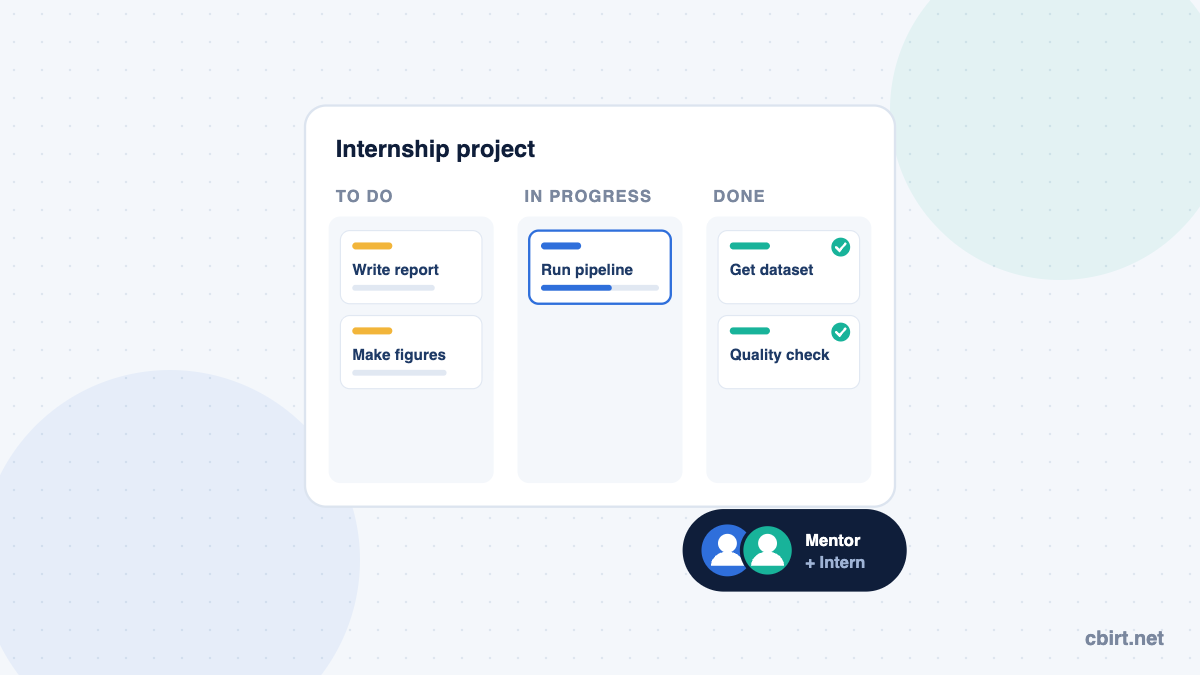
One finished project with clean code and a one-page write-up will set you apart from most applicants. Pick one that matches your direction:
| Project | Free data source | Tools | Shows you can… |
|---|---|---|---|
| Phylogeny of a gene family | NCBI GenBank | BLAST, multiple sequence alignment, a tree builder such as IQ-TREE or MEGA | Handle sequences and interpret evolutionary relationships |
| Differential gene expression | NCBI GEO (RNA-seq count data) | R with DESeq2, plots in ggplot2 | Run statistics on real expression data |
| Variant calling on a small genome sample | NCBI SRA | FastQC, BWA, SAMtools, GATK | Run a full NGS pipeline from reads to variants |
| Protein–ligand docking | RCSB PDB and PubChem | PyMOL, AutoDock Vina | Work on structure-based drug discovery |
| Cancer genomics exploration | TCGA, via the NCI Genomic Data Commons | Python or R | Analyze clinical-scale public datasets |
Put each project in a GitHub repository with a README that states the question, the data, the steps and one clear result. Link it in your CV and in the first lines of your email. For ten project ideas with free datasets, see our list of bioinformatics projects; for the roles they lead to, see bioinformatics jobs for freshers.
Training internships at CBIRT
CBIRT’s internships are training internships: industry-focused skill development programs, run live online by experienced trainers. We say so upfront, show fees before you register, and make no placement guarantee. Each program ends with an assignment or project, and every learner who completes it receives a certificate.
| Program | What you learn | Length |
|---|---|---|
| Python & Biopython + R internship package | Programming for biological data, from sequences to statistics and plots | 1 month |
| WGS + GWAS internship package | Whole-genome sequencing analysis from reads to variants, then genome-wide association studies | 1 month |
| Summer internships | Themed bootcamps such as genome analysis or AI for drug discovery | 4 weeks to 2 months |
See current internship dates and fees →
Not sure whether you need a degree, a course or an internship first? Read our guide to bioinformatics courses in India.
Frequently asked questions
How do I get a bioinformatics internship in India?
Learn the basic toolkit (Linux, Python or R, databases, BLAST), build one project on public data, then apply to formal programs and email faculty directly with a short, specific message.
Are there paid bioinformatics internships?
Yes. The DBT-supported BIITP pays ₹10,000 a month, the Science Academies’ summer fellowship gives a monthly fellowship and train fare, and many industry internships pay a stipend.
Can I do a bioinformatics internship online?
Yes. Many training internships and some industry internships run fully online, because the work happens on a computer. Research labs more often expect you on site.
When should I apply for a summer internship?
Start in the autumn before. Formal programs close early; the Science Academies’ fellowship closed on 31 January for summer 2026.
Is it wrong to pay for an internship?
Not if it is honestly a training program with named trainers, a real project and no job promises. Avoid anything that charges a fee and promises placement.
What should I put in my internship application?
A one-page CV, a link to a project on GitHub, and a short email that names the person’s work and the dates you are available.
Sources
- India Science, Technology & Innovation portal: Bioinformatics Industrial Training Programme (BIITP)
- Indian Academy of Sciences: Science Academies’ Summer Research Fellowship 2026
- IBAB: Internship
Related reading on CBIRT: Bioinformatics course in India · Bioinformatics databases and tools · Bioinformatics jobs for freshers · Bioinformatics projects for your portfolio