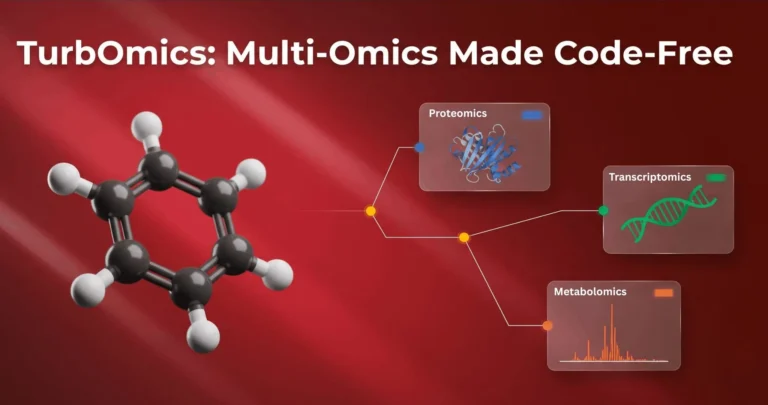
TurbOmics: A Free, No-Code Web Platform That Puts Metabolomics at the Center of Multi-Omics Analysis
TurbOmics, a free web platform from CNIC and EMBL, integrates metabolomics with proteomics and transcriptomics data, no coding needed.
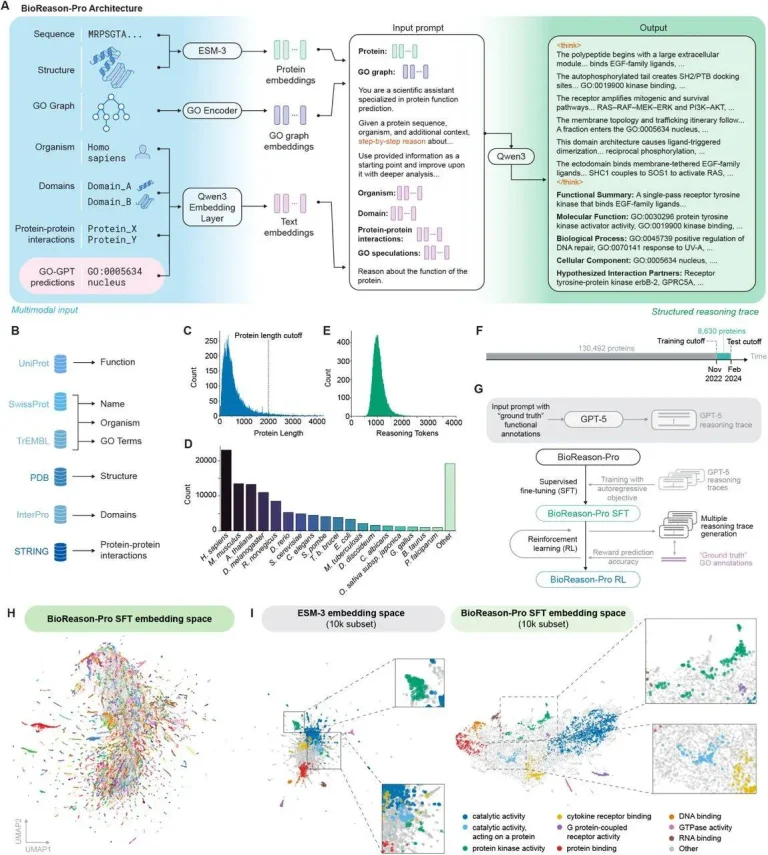
A team of scientists from the University Health Network – Canada’s Hospital, Arc Institute and Vector Institute developed BioReason-Pro to tackle one of the greatest challenges in biology: protein function prediction. Unlike existing AI tools, which give baffling black-box predictions, BioReason-Pro generates structured reasoning that explains why a protein is assigned a function. By integrating…
Molecular biology is currently undergoing a taxonomic reckoning. For decades, the human genome was defined by a stable, canonical figure: roughly 19,500 to 20,000 protein-coding genes. These established sequences form the bedrock of drug development and clinical diagnostics. However, a major collaborative effort is now proving that this “canonical” view is merely the tip of…
A team of researchers from the University of Edinburgh and collaborators from institutions like Stanford and UC San Francisco have tackled a central question in biotechnology: can we make protein expression predictable and routine? Their review, published in Trends in Biotechnology, explores why expressing proteins in host organisms remains a challenge, what’s holding the field…
Functional proteomics makes the identification of new biomarkers and treatment targets easier by offering vital insights into cancer mechanisms. By combining information from over 900 samples from the Cancer Cell Line Encyclopedia and nearly 8000 patient samples from The Cancer Genome Atlas, researchers have created a comprehensive cancer functional proteomics database employing reverse phase protein…
In a groundbreaking study from the Whitehead Institute for Biomedical Research and MIT’s Computer Science and Artificial Intelligence Laboratory, researchers have uncovered a hidden layer of biological organization—protein sequences contain codes that determine their precise location within a cell. This study introduces ProtGPS, an AI-driven model that predicts and manipulates protein localization with unprecedented accuracy….
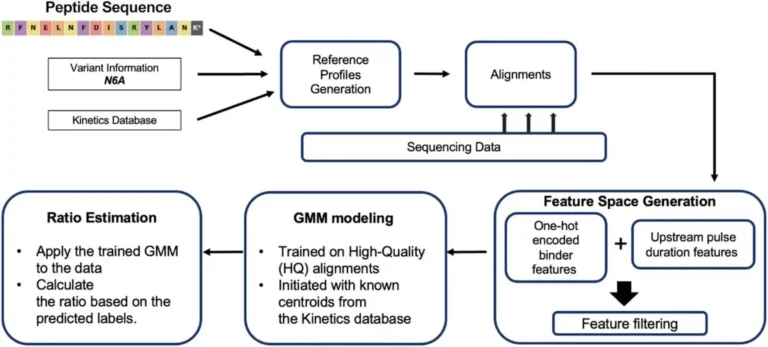
Single-molecule Next-Generation Protein Sequencing (NGPS) provides a powerful alternative to mass spectrometry for analyzing protein variants, allowing detailed identification of proteoforms and amino acid changes at the individual molecule level. New data analysis techniques and bioinformatic tools must be developed to handle the unusual data type produced by NGPS. Here, scientists from Quantum-Si introduce ProteoVue™,…
Proteins are the most essential molecules for all forms of life on Earth. They perform a vast number of actions vital for life. However, the immense intricacies of these molecules leave so many questions to be answered. How are they shaped? What tasks do they accomplish? What are their implications for human beings and the…
Making synthetic protein sequences from protein structures is a powerful use of protein engineering technology. It can be challenging to create designed proteins, though, because poor codon sequences can result in low expression rates in organisms like yeast. Scientists from CSAIL-MIT and Harvard Medical School present CodonMPNN, a system that produces a codon sequence conditional…
Determining the function of proteins is one defining aspect of molecular biology that also carries great potential in drug discovery and development. A better comprehension of what the proteins do leads to faster discovery of valuable drug targets, which in turn saves the resources related to laboratory work, the purpose of which is the search…
AlphaFold is a database of protein structures and predictions. It contains predictions for ~214 million proteins. AlphaFold2, developed by DeepMind, has dramatically scaled our capability to predict protein structures in silico. The extent of this data is overwhelming, and there are challenges regarding protein annotation, which practically applies to the information. Hence, researchers from the…
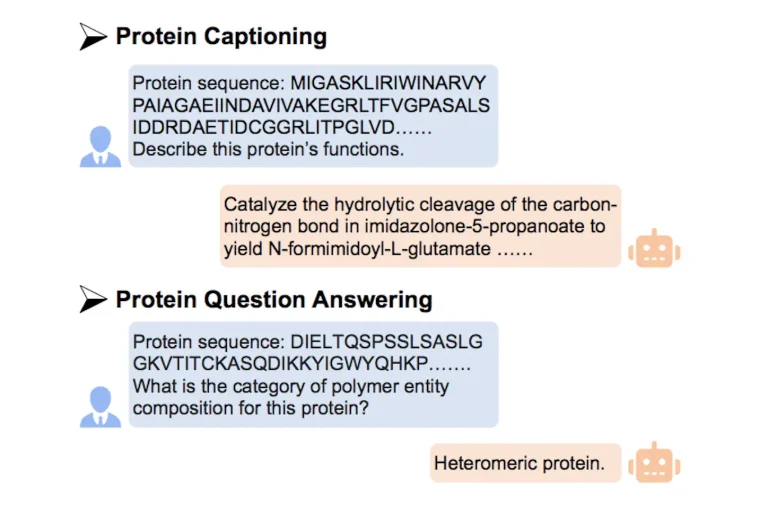
ProteinGPT was developed jointly by specialists from the University of California in Los Angeles and the Georgia Institute of Technology and Meta AI. The model is performed on the transformer framework, which has been proven to work on numerous natural language processing applications. As the information revolution progressed within the past few decades, the focus…
Protein structure is important and should be studied to understand many biological processes and disease progressions. There are many advancements using machine learning techniques, but accurate protein sequencing remains a challenge in the field. Protein sequencing typically depends on mass spectrometry (MS), and they face limitations in accurately identifying all the amino acids. Researchers from…
Scientists from Yale University, UCLA, and UT Health have introduced Geneverse, a collection of fine-tuned LLMs and multimodal LLMs (MLLMs) for genomic and proteomic research. These models address three novel tasks: generating gene function descriptions, inferring protein functions from structures, and selecting marker genes from spatial transcriptomic data. Artificial intelligence (AI) is being adopted more…
Sequence-to-structure predictions are the main focus of current computational methods for reverse translation, which is the process of translating complicated protein structures into sequences. This is how protein design is traditionally understood. The researchers from the InsAIght Research Center and the Public University of Navarra present StructureGPT, a cutting-edge deep learning model that translates complicated…
Bioinformatics, in its continuous advancement, depends on the detailed examination of proteins within its molecular domain. Proteins, the working structures of the cell, have a hand in nearly all intracellular activities. Depending on their structures and the relationships between them, all of their functions determine why and how the investigation of proteins is paramount in…
The discovery of ProtT3 marks a significant recent advance in the fast-developing science of bioinformatics. ProtT3, developed by researchers at the National University of Singapore, the University of Science and Technology of China, and Hokkaido University, combines Language Models (LM) with protein sequence analysis. It provides unparalleled insights into the complicated world of proteins by…
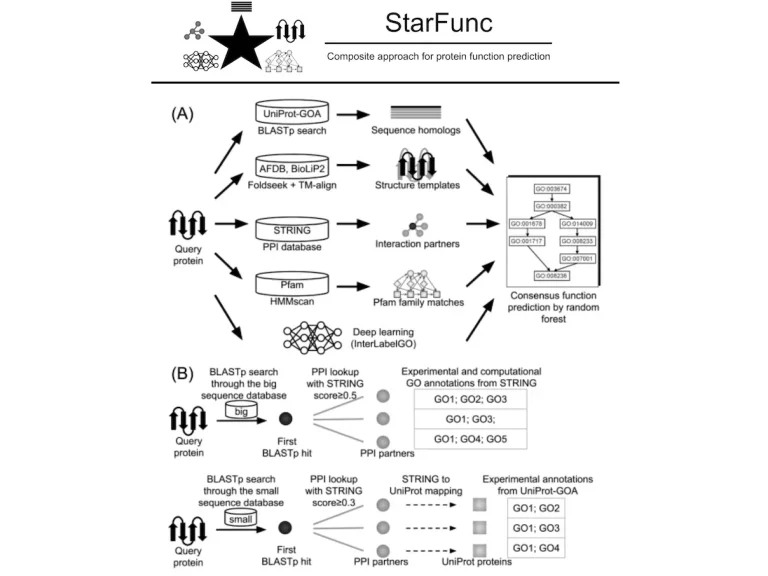
A recent study by the Chengxin Zhang lab from the University of Michigan introduced StarFunc, an accurate protein function prediction approach integrating cutting-edge deep learning with template data from sequence homology, protein interactions, structural similarities, and domain families. Rather than picking sides, however, StarFunc combines two worlds to create a unified framework. This creative idea…
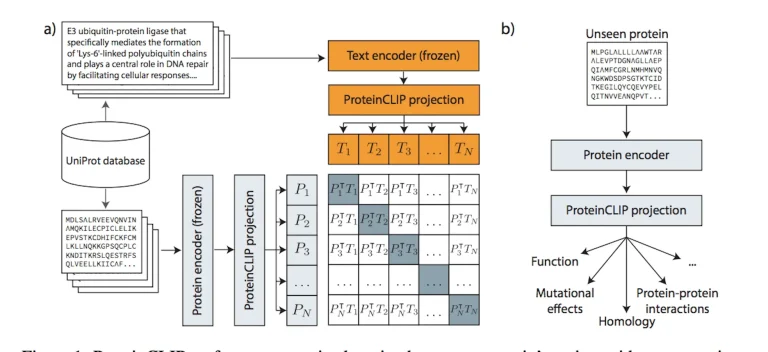
Language models have made a new era of biological sequence modeling possible. However, it is still difficult to extract significant sequence-level embeddings from these models. ProteinCLIP, which employs contrastive learning between a protein’s amino acid sequence and curated literature detailing its function, is introduced by Stanford University researchers in this paper. Thus, ProteinCLIP learns to…
The subject of protein engineering has shown great promise for protein language models. Unfortunately, the main size at which the existing protein language models function is the residue, which restricts the information that they can convey at the atom level. Because of this restriction, we are unable to fully utilize the potential of protein language models for…
Can you imagine that you can design proteins that have a particular function, and they are like small robots working inside our cells? This may be the reality pretty soon. Researchers from the University of California and Yale University came up with an innovative way of creating transmembrane proteins from scratch, thus leading to targeted…
PROTLLM is a versatile crossmodal large language model (LLM) proposed by Beijing Institute of Technology researchers designed for protein-centric and protein-language tasks. It can handle complicated inputs with natural language text mixed with an arbitrary number of proteins thanks to its dynamic protein mounting technique. By creating a specialized protein vocabulary, the proteins-word language modeling approach…
The versatile workhorses of our cells, proteins, are essential to many biological processes. Numerous scientific endeavors, such as medication research and the creation of biomaterials, depend on our ability to comprehend their structure and function. Protein research has always been a laborious and time-consuming process. However, protein language models (PLMs) are revolutionizing this field by…
Recent advances in large language models (LLMs) and transformers have opened new possibilities for modeling protein sequences as language. Carnegie Mellon University researchers have developed a new AI model called GPCR-BERT that leverages advances in natural language processing to uncover new insights into the sequence-function relationships in G protein-coupled receptors (GPCR), which are the target…
The laborious aspects of acquiring and curating data sets for machine learning, especially in proteomics-based systems, present unique difficulties because there is a significant amount of data reduction from raw data to machine learning-ready data. In spite of the difficulties with accessibility and repeatability, laboratories frequently employ distinctive and intricate data processing pipelines to maximize…
The field of biological sequence analysis has lately benefited from the revolutionary changes brought about by the development of self-supervised deep language models for natural language processing tasks. Conventional models show significant effectiveness in a variety of applications. These models are mostly based on the Transformer and BERT architectures. However, the quadratic computational complexity O(L2)…
Protein design has seen significant progress, but a comprehensive deep-learning framework for protein design, including de novo binder design and higher-order symmetric architectures, remains unexplored. Diffusion models have shown success in image and language generative modeling but have limited success in protein modeling due to the complexity of protein backbone geometry and sequence-structure relationships. The…
One of the primary challenges contemporary neuroscience researchers face is building a successful and accurate computational model of the various sensory systems in the body. Such a model could, in theory, replicate the outputs produced by these biological sensory systems when given identical stimuli and could help improve our understanding of how the brain functions…
Dalhousie University, Canada researchers have developed a new web-based tool called Multiple Protein Profiler (MPP) that can efficiently calculate 12 key physicochemical properties of multiple protein sequences uploaded by users. Existing protein analysis tools are limited to single sequences, but MPP enables high-throughput batch analysis of entire proteomic datasets. The computed parameters provide insights into…
Through mass spectrometry-based proteomics, a German-Danish research team led by Matthias Mann has developed a new screening tool to identify alcohol-related liver disorders at an early stage. Taking two or three drinks every day may put your liver in trouble. Researchers have developed a new tool that uses proteomics and machine learning to predict whether…
Scientists from the National Cancer Institute, Bethesda, and the University of Maryland have developed a computational tool to determine gene-target combinations for personalized cancer therapies. The tool has the potential to aid in the creation of novel combinatorial treatments for cancer patients. For mining a vast cohort of single-cell transcriptomics information, the scientists utilize combinatorial…
In a report published in Nature Communications, researchers from the Department of Oncology-Pathology at Karolinska Institutet, Sweden established a cell line resource dataset and analysis tool ‘Functional Omics Resource of ALL (FORALL)’ that could be used to uncover the features that make specific leukemias vulnerable to new forms of targeted medicines. The researchers used proteomics,…
| Cookie | Duration | Description |
|---|---|---|
| cookielawinfo-checkbox-analytics | 11 months | This cookie is set by GDPR Cookie Consent plugin. The cookie is used to store the user consent for the cookies in the category "Analytics". |
| cookielawinfo-checkbox-functional | 11 months | The cookie is set by GDPR cookie consent to record the user consent for the cookies in the category "Functional". |
| cookielawinfo-checkbox-necessary | 11 months | This cookie is set by GDPR Cookie Consent plugin. The cookies is used to store the user consent for the cookies in the category "Necessary". |
| cookielawinfo-checkbox-others | 11 months | This cookie is set by GDPR Cookie Consent plugin. The cookie is used to store the user consent for the cookies in the category "Other. |
| cookielawinfo-checkbox-performance | 11 months | This cookie is set by GDPR Cookie Consent plugin. The cookie is used to store the user consent for the cookies in the category "Performance". |
| viewed_cookie_policy | 11 months | The cookie is set by the GDPR Cookie Consent plugin and is used to store whether or not user has consented to the use of cookies. It does not store any personal data. |